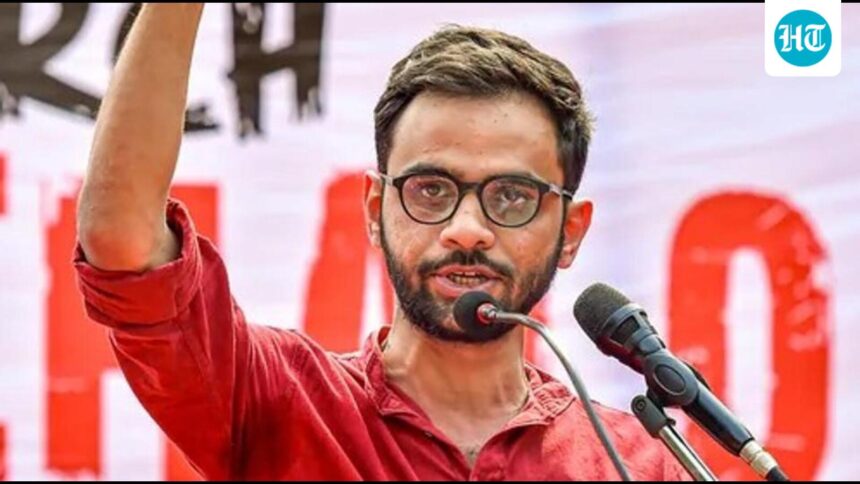
Former Jawaharlal Nehru University (JNU) student Omar Khalid on Monday urged the Supreme Court to allow open court hearing and oral arguments in his review petition challenging denial of bail in the alleged larger conspiracy case linked to the 2020 Delhi riots.

Senior advocate Kapil Sibal, representing Khalid, referred the matter to a bench led by Justice Aravind Kumar, who also passed the January 5 order denying bail, requesting that the review be heard in open court instead of a decision being taken in chambers.
“I wanted to point out the review petition… it was listed on Wednesday. My request is… if you can file it in open court,” Sibal said.
“We will look into the document and, if necessary, summon it,” Justice Kumar said.
Review applications are usually decided in chambers by judges, without oral arguments or public hearings in court.
Khalid has filed a petition to review the Supreme Court’s January 5 judgment, which denied him bail under the stringent provisions of the Unlawful Activities (Prevention) Act (UAPA) in the Delhi riots conspiracy case.
A bench comprising Justice Kumar and Justice NV Angaria held that the material on record revealed a prima facie case against Khalid and co-accused Sharjeel Imam, and attributed to them a “central and formative role” in the alleged conspiracy. The court noted that their involvement extended to “planning, mobilization and strategic direction,” putting them on equal footing with the other defendants.
The Supreme Court rejected the bail application, ruling that lengthy imprisonment alone cannot justify release in cases governed by the UAPA, as courts must first assess the seriousness of the allegations and whether the legal limit for bail has been exceeded.
Read also:Kunal Kamra, Zahran Mamdani and more pen letters and articles about Omar Khalid, who spent 5 years in prison, in a new book
“In prosecutions affecting the sovereignty, integrity or security of a state, delay cannot serve as a trump card,” the ruling said, stressing the need to evaluate the role of the accused in each individual case.
Khalid has been in detention since September 13, 2020, while Imam has been in detention since January 28, 2020. All the accused in the case face trial for allegedly being part of a coordinated conspiracy that culminated in communal violence in northeast Delhi in February 2020, leaving 53 people dead and hundreds injured.
While the court refused to release Khalid and Imam on bail, it granted bail to five other accused – Gilvisha Fatima, Meeran Haider, Shifaur Rahman, Muhammad Saleem Khan and Shadab Ahmed, holding that the allegations against them were “of ancillary or facilitative nature”.
The court explained that criminal law does not impose identical findings simply because the allegations arise from the same set of facts, and that Khaled and the imam stand on “qualitatively different grounds.”
The January 5 order also imposed restrictions on Khalid and Imam, allowing them to renew their bail application only after questioning protected witnesses or after one year, whichever is earlier.
The bail applications were based on a September 2025 order by the Delhi High Court, which refused bail to nine accused and described Khalid and Imam as the “intellectual architects” of the violence. While Khalid was not physically present in Delhi during the riots, the Imam was already in custody when the violence broke out. The defendants argued before the Supreme Court that they were exercising their constitutional right to protest and had no role in provoking the violence. They also asserted that their lengthy imprisonment amounted to punishment without a trial, with several supplementary indictments filed and dozens of witnesses still to be questioned.
Read also:Omar Khalid tells court he was targeted by Delhi Police despite lack of evidence
However, the Supreme Court held that in cases governed by the UAPA, long imprisonment by itself cannot override the legal standard that the court is satisfied that there is a prima facie case against the accused.
It also rejected the claim that Khaled and the Imam remained in detention only because of the inaction of the Public Prosecution. It noted that the record, including the findings of the Delhi High Court, does not support a blanket depiction of a “sluggish trial” or “undue delay” sufficient to override the statutory prohibition under Section 43(d)(5) of the UAPA, which imposes a strict statutory bail regime and places the onus on the accused to convince the court of his or her innocence.