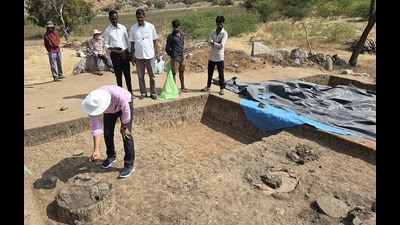
A team led by a scholar from Hartwick College, USA, has discovered a largely intact human burial site, along with other Neolithic and later artefacts, at Tekkalakot in Ballari district.
A researcher inspects an excavation trench in Tekkalakot on Sunday. (HT Photo)The discoveries were made in the Gaudra Mul hill range on the southwestern edge of Tekkalakot, people familiar with the matter said.
Namita S Sugandhi, associate professor of anthropology at the college, led the research team, which included researchers from the Indian Institute of Technology, Kanpur. Yasswini Jayadevaya, G Rohini, a post-graduate scholar at the Central University of Karnataka, and V Ashok Abkari, a local scholar and former school teacher Sugan’s former teacher, who was Sugan’s former teacher.
“Tekkalakot is an exceptional archaeological site as traces of the Stone Age, Neolithic Age and Early Metal Age are all found in one area. This helps us understand nearly 5,000 years of human history in a systematic manner,” said Sugandhi.
“The excavations have yielded significant evidence of early human habitation. We have discovered pottery shards, stone tools and other objects that clearly belong to the Neolithic and Early Iron Age,” he added.
More Read

A key discovery in the latest round of excavations is a large intact human skeleton measuring about 5.5 feet in length. “The burial pattern is very unique. Stones were placed on the bodies as part of the funeral rituals, which gives us a valuable insight into the burial practices of that era,” Sugandhi said.
The latest round of excavations took about a month, the researchers said, with three specialized teams engaged in contiguous surveys at multiple locations.
According to Sugandhi, the sites of Tekkalakot were discovered in 1963 by MS Nagaraja Rao of the Deccan College, Pune during a survey of the Tungabhadra valley and were first excavated in 1964 under the supervision of HD Sankalya.
More Read
Sugandhi has participated in multiple rounds of surveys and excavations in the area since 2005. In a research paper published in 2022, he posited an approximate timeline for the occupation of Tekkalakot by a Southern Neolithic culture spanning 3000–1200 BCE.
The team also found beads of various sizes and large clay pots about two feet high and one foot in diameter. “Some of these vessels have nail-like impressions and intricate designs. It is possible that these vessels were used in burial rituals,” he added.
Susan Kirkpatrick Smith, a bioarchaeologist at Kennesaw State University in the US, is helping to preserve the skeletal remains and carry out scientific research to determine their age. “Although many pottery sherds are broken, we are working on ways to preserve and reconstruct them for detailed analysis,” Sugandhi noted.
The researchers noted that the process of dating and classifying the artifacts is still ongoing.
Local authorities said the findings could help develop Tekkalakot as a destination for historical and archaeological tourism. The area around Tekkalakot also has considerable medieval remains, which Sugandhi has already mentioned require further in-depth study.