Logo text
We have had impressive access for several years to the Burning Man Festival, its participants, and bureaucracy, but it has been undone by indecision about its structure, themes, and purpose. Jehan Noujaim and Vikram Gandhi The man will burn It is an attractive puzzlement.
Over its fast-paced, disjointed four-hour running time, the HBO docuseries delivers some of the sense of community that Burning Man offers and cultivates, as well as its evolving infrastructure and internal political conflicts; some awareness of the inherent and overwhelming whiteness and privilege underlying the event; Some thoughts on several turbulent years in Burning Man’s history; And some interest in the challenges facing Burning Man as it looks to the future. But at almost every turn, the series is overshadowed by an excess of material and insufficient clarity and precision.
The man will burn
Bottom line Attractive, but rarely digs deep.
Broadcast date: 9pm Thursday, July 9th
Managers: Jehan Njeim and Vikram Gandhi
finally, The man will burn It’s too much of an extended commercial for an event that doesn’t need advertising, and not enough to go into depth. However, if a well-shot and well-sourced Burning Man commercial is what you’re looking for, there’s a lot of good stuff here.
The man will burn It begins in the days leading up to the big announcement of the 2021 festival. As you may recall, there was an ongoing global pandemic and events were still being canceled on a regular basis, but CEO Marian Goodell, Burning Man’s board of directors, and the community were divided. Would it have been better to cancel the 2021 event, giving attendees an extra year of vaccinations and coronavirus mitigation in the name of triumphantly bringing the festival back in 2022? Or was it necessary to bring back Burning Man for the sake of the brand’s values, its passionate fans, and its economic solvency moving forward?
Much to the dismay of board member, investor and Elon’s brother Kimbal Musk — who gives the strong impression that “entitlement” is a genetic condition — the decision was made to postpone Burning Man for another year. This was also disappointing for Lindsey, a professor who teaches the online courses from Pasadena, and Ray, a Black veteran in rural North Carolina.
Both Lindsay and Ray were planning to attend Burning Man for the first time, creating an entry point for spectators, explaining the appeal, from their perspective, of deciding to become “burners.” Presumably the point is that no two new arrivals are identical.
We hear and see how the festival, a mixture of culture, art, music, sex and drugs, appealed to them. Meanwhile, we learn about the origins of Burning Man, going back to its Bay Area roots, and a mission that extended to the Nevada desert and then around the world. We meet many of the original founders, born out of the Cacophony Association, including John Law and Michael Mikel, as well as the new generation of leaders who took the reins in 1999 with the founding of Black Rock City LLC.
Like any business/creative endeavor, there were different agendas in planning and coordinating Burning Man, and while Goodell and Musk may have wanted different things, they only wanted what was best for Burning Man — a friendly spirit of adaptation that is no less compelling, but stems from the close involvement between the filmmakers and the Burning Man Project (BMP).
Or, in other words, my kingdom to hear what Goodell and other Burning Man idealists think about Musk and the festival’s reliance on a slew of Silicon Valley millionaires and billionaires who think they know what’s best.
Instead, the documentary finds that despite superficial conflicts, everyone wants what they believe is best for Burning Man, and the disagreements are deep but benign. This means that so many people echo different party lines regarding the festival and its ideal, that Burning Man becomes borderline indistinguishable from the various sects that have been the focus of recent documentaries, including two seasons of The vow on HBO, both directed by Njeim. Except there was less interest in NXIVM looking good in the end The vow.
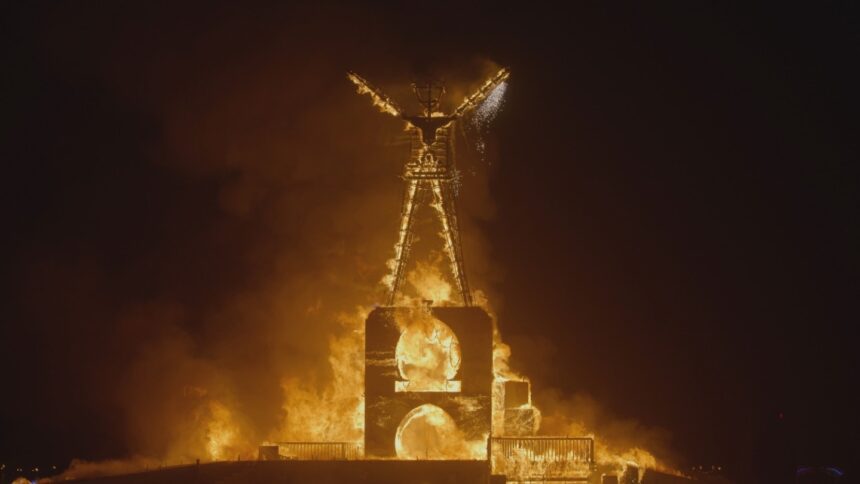
The festival is characterized by its photogenic appeal, bringing together eclectically dressed (and non-lingerie) participants, dazzling fireworks, and a self-conscious evocation of events. Mad Max Movies, fantastic, risky art projects, and the vast expanses of the Nevada desert that turn every year into a symbolic functional city with a population of more than 80,000. The festival and its surroundings are so inherently captivating that you can appreciate the skill of the documentary’s heavy cinematography without dwelling on the fact that Burning Man is a highly ambitious festival populated by geniuses, artists and risk-takers while The man will burn He has no artistic ambitions of his own and takes no risks. The show does not reflect the sensitivity of the thing it documents, nor does it try to.
A variety of veterans appear in the documentary, including artists, logistical organizers, and general enthusiasts who guide the narrative. I think you can come away with it The man will burn With a powerful if thoroughly redacted version of what the festival is now — an event in which the interim committee’s biggest adversaries are cell phones, social media influencers and the media, which continues to treat Burning Man with sensationalized voyeurism. We’re told this caused major problems when details of the destruction and ruin were allegedly misreported during the rain-soaked 2023 event. Here, we are reassured that everything was absolutely fine, and that the photography of the flooded desert plains is so beautiful that only a square could object to the repeated phrase “It’s OK! We’re all OK!” Party line.
The film gets some drama from the 2021 cancellation and ensuing “Renegade” event, the attempt to bring the festival back under the regulatory umbrella the following year, and then the 2023 deluge. Subsequent years have had more drama of their own, especially when it comes to Burning Man’s financial issues, but The man will burn The matter stops in 2023, as if all the problems have been overcome or at least are not worth pursuing even after three years. This is just one of many places where the series verges on the brink of separating from the “this is a community of strangers and this is a family!” agenda, but it goes no further than that.
The episodes tiptoe around the city and mantle conflicts between Burning Man, local businesses, and law enforcement in Gerlach, Nevada. Then the doc stops talking about them, because it doesn’t establish a history of concerns darker than “Where will hippies defecate if there aren’t enough toilets?” The episodes revolve around larger aspirations for the festival, including purchasing the surrounding land in the desert and talk of some kind of “philosophical center.” Then the doc stops talking about them. You sense there’s a coup brewing between the board and traditional leadership, with Musk as a potential villain. Then the Doc stops talking about it, and concludes with completely implausible protestations of respect from apparent enemies. Almost every story involving a featured character reaches a point of seemingly happy resolution and then the documentary moves on.
At no point does it feel like Burning Man or its main characters are pressuring the filmmakers to push a particular version of reality, nor does it feel like HBO asked to smooth out any rough edges. But the feeling throughout is that the filmmakers are more keen to casually engage than interrogate, to stare and listen to cultural jamming rather than ask tough questions. There is editing for The man will burn It could be shorter and narrower and perhaps more exciting, it could be longer and richer and more complex, but instead we get an interstitial series that’s fun, shallow, and, finally, bland in a way Burning Man has always tried to avoid.