Image: Generative Artificial Intelligence/Gemini
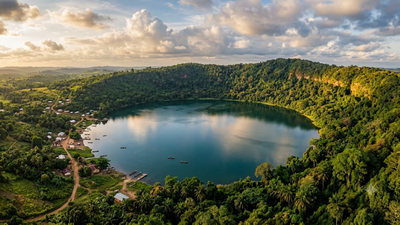
Lake Bosomtwe appears from space as a near-perfect blue circle surrounded by dense forests in southern Ghana. Revered by the local Ashanti people and called the “Lake of Souls,” this place is much more than just a picturesque landmark.
About 1 million years ago, a huge meteorite crashed into Earth, creating a crater about 10.5 kilometers across, and permanently changing the landscape. This impact released massive amounts of energy, fractured deep rocks and changed the geology of the area in ways that still shape it today. Scientists believe these ancient processes helped concentrate precious metals, including gold, in the surrounding crust.
Today, Lake Bosomtwe is one of the best preserved archaeological craters in the world and a fascinating record of Earth’s violent past and its hidden geological riches.
How did a meteorite fall create Lake Bosomtwe in Ghana?
Lake Bosomtwe occupies a crater left by a meteorite estimated to have struck Earth about one million years ago. Moving at tens of kilometers per second, this space rock released energy equivalent to millions of tons of TNT upon impact, creating a vast circular depression that later filled with rainwater to form the lake we see today.
According to NASA’s Earth Observatory, Lake Bosomtwe is one of the few well-preserved meteorite craters in the world and the only natural lake in Ghana that resulted from an extraterrestrial impact. Its perfectly circular shape remains clearly visible in satellite images, making it a valuable site for studying planetary influences.The crater has become an important natural laboratory, helping scientists understand how meteorite impacts are reshaping landscapes on Earth and other rocky planets.
Why is Lake Bosomtwe known as the “Lake of Souls”?
For the Ashanti people, Lake Bosomtwe holds deep spiritual significance. According to local tradition, the souls of the deceased come to the lake to bid farewell to the god Tui before entering the afterlife, leading to its enduring nickname “Lake of Souls.”The cultural importance of the lake has helped preserve much of its natural environment over generations. Traditional beliefs have long discouraged some activities around its shores, reinforcing its role as a sacred landscape and ecological refuge.UNESCO recognizes the importance of preserving sites where natural heritage and cultural traditions are closely intertwined, and Lake Bosomtwe remains one of the most important examples of this relationship in Ghana.
how Meteor impact Help concentrate gold around the hole?
Although the meteorite did not bring gold to Earth, the impact dramatically changed the surrounding rocks. Enormous pressure and heat fractured the Earth’s crust, creating networks of fissures through which mineral-rich hydrothermal fluids could circulate.
Over long geological timescales, these fluids deposited gold and other precious metals within fractured rocks.According to the United States Geological Survey (USGS), hydrothermal systems are among the most important geological processes responsible for concentrating economically valuable minerals, including gold. High impact structures can create favorable conditions for these mineral fluids by increasing the permeability of rocks and generating intense heat.Study published in Journal of African Earth Sciences It states that the area around Lake Bosomtwe lies within Ghana’s famous Beremian geological formations, which already host some of the richest gold deposits in Africa. The ancient impact is believed to have further affected local geological structures, contributing to the mineral wealth of the region.
Why do scientists continue to study Lake Bosomtwe?
Lake Bosomtwe is more than just a meteorite crater; It is also one of the world’s most valuable climate archives.
Sediments accumulating on the lake floor have remained largely undisturbed for hundreds of thousands of years, preserving detailed records of rainfall, vegetation and environmental change across tropical western Africa.Researchers have extracted deep sediment cores that allow scientists to reconstruct past climate patterns and understand how ecosystems responded to natural environmental shifts. These records provide one of the longest continuous histories of tropical African climate ever recovered.The crater is also an important counterpart to impact structures elsewhere in the solar system. By studying Bosomtwe, planetary scientists are gaining insights into how meteorite impacts affect the geology, hydrology and even the potential habitability of planetary surfaces.
Could another impact like Bosumtwi happen again?
Meteorite impacts capable of creating craters the size of Lake Bosomtwe are extremely rare, but they remain a natural part of Earth’s history.
Modern monitoring programs continuously track near-Earth objects to identify asteroids that could pose future risks. Ongoing surveys continue to improve humanity’s ability to detect potentially dangerous objects decades before any potential impact.Although catastrophic impacts are unlikely during our lifetime, Lake Bosomtwe remains a stark reminder that Earth’s surface was shaped not only by volcanoes, earthquakes and erosion, but also by powerful events originating outside our planet.