

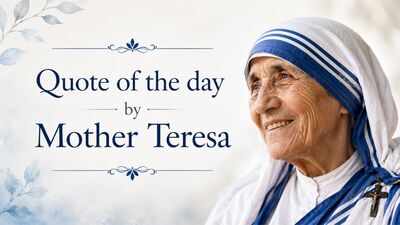
Quote of the Day by Mother Teresa (Image generated by AI)
Mother Teresa spent decades working among the sick and dying in Calcutta, and believed that it was a form of suffering that had gone largely unnoticed by modern medicine. “The greatest disease in the West today is not tuberculosis or leprosy; it is being unwanted, unloved, and uncared for,” she said.
“We can cure physical ailments with medicine, but the only cure for loneliness, despair and hopelessness is love.” She was drawing a specific contrast between the physical poverty she saw daily in India and the quieter emotional poverty she observed in wealthier countries, where people had enough to eat but no one checked if they were okay. It is a distinction she returns to often in her later writings, having spent enough time in both places to talk about disagreement with real authority.
Today’s quote by Mother Teresa
“The greatest disease is not tuberculosis or leprosy, it is the absence of a desirable person and neglect. We can cure physical illnesses with medicine, but the only cure for loneliness is love.”
Meaning and interpretation of Mother Teresa’s saying
Mother Teresa spent her life treating tuberculosis and leprosy, diseases she understood better than anyone else. However, I have come to believe that there is another condition that causes real suffering, which is the feeling of not having a place in anyone’s life.Being unwanted does not mean being alone. A person can live alone and feel loved by family and friends. Another person could be surrounded by people every day and still feel completely invisible.
Mother Teresa was referring to the second type of isolation, which is the feeling of not being important to anyone.The second half of the quote is equally important. She did not refuse medicine. She has spent her life caring for people whose bodies need real healing. Her point was that medicine has limits. It can treat an infection or relieve pain, but it was never designed to replace someone else who chooses to sit with you.
The lesson Mother Teresa learned from the streets of Kolkata
This conviction did not come from a book. It came from years I spent in neighborhoods where poverty and abandonment went hand-in-hand.
Many of the people she cares for have had families estranged from them due to illness or age. What I noticed over and over again was that their deepest fear was rarely death itself. It was the idea that no one would notice if they disappeared.It changed the way she approached her work. Food, medicine, and shelter were of great importance, but she believed that they only fully did their job when someone offered them attention and warmth by their side.
Conversation or the desire to sit quietly next to someone brings back something that supplies alone cannot.
Why the quote seems more relevant in today’s world
People are now more connected to technology than ever before in Mother Teresa’s lifetime, yet loneliness continues to emerge as a serious concern in surveys in many countries, especially among older people and young people. Staying in constant contact with others does not mean feeling cared for.A person can send a hundred messages a day and still feel completely lonely. Another person may have a few close relationships and feel completely supported, because these relationships are real. Mother Teresa’s quote speaks directly to that gap. True care requires presence and attention, not just contact.
Love is often shown in the smallest gestures
Not everyone can start a charity or spend their lives doing humanitarian work. Almost anyone can do smaller things that make someone’s day less hectic.
Checking in on a neighbor who’s gone silent, sitting with a friend who seems introverted, or simply listening properly instead of waiting for your turn to speak, none of these cost anything, and they all tell someone else that they’re not invisible.Researchers who study well-being consistently find that people who feel truly connected to others deal better with stress and difficult times. Mother Teresa came to the same conclusion through decades of direct observation, long before it became something taught in universities.
Other famous quotes by Mother Teresa
- “We cannot all do great things. But we can do small things with great love.”
- “If you judge people, you won’t have time to love them.”
- “Peace begins with a smile.”
- “Kind words can be short and easy to say, but their repercussions are truly endless.”
- “Spread love everywhere you go. Don’t let anyone come to you without leaving you happier.”
A message that will remain immortal across generations
Medicine will continue to advance, and that is a good thing. New treatments will continue to save lives and relieve previously unanswered suffering. But there will always be moments when more than a prescription is what a person needs. A lonely patient, grieving neighbor, or struggling friend is more likely to remember who they sat with than the details of any treatment they received.This is really the essence of what Mother Teresa was saying. Physical illness deserves medicine and skill. Emotional isolation deserves something completely real, given freely and without expecting anything in return.