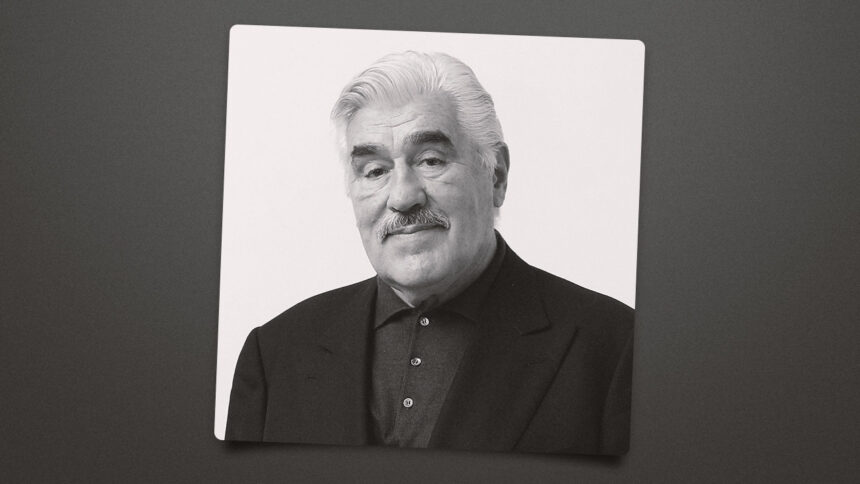
Mario Adorf, the German-Italian actor who achieved legendary status in Europe by playing charismatic villains in crime thrillers, spaghetti westerns and dramas as an Oscar-winning Tin drumHe died. He was 95 years old.
Adorf, whose career spanned decades across cinematic genres and eras, died Wednesday at his home in Paris after a brief illness, his agent announced.
His breakthrough came with his role as a Nazi-era serial killer in Robert Siodmak’s Oscar-nominated thriller. Satan strikes at night (1957), and became a favorite among directors of the New German Cinema movement of the 1960s and 1970s.
He played Oscar Matzerat’s father in Volker Schlöndorff’s film Tin drum (1979) and had supporting roles in Schlöndorff and Margarethe von Trotta Lost Honor by Katarina Bloom (1975) and Rainer Werner Fassbinder Lola (1981).
Tin drum Won the Palme d’Or at Cannes (tied with Francis Ford Coppola Apocalypse now) Then the Academy Award for Best Foreign Language Film. It was a step forward for Adorf, who had cut his teeth as a heavyweight in spaghetti Westerns and Italian mafia films of the 1960s.
In Germany, he is perhaps best known for his villainous role as the black-hatted cowboy who murders the family of the Apache hero V Winnetou (1963), a Western European film filmed in then-Yugoslavia, which still enjoys cult status to this day.
Adorf was born in Switzerland, the illegitimate son of an Italian surgeon and a German medical assistant, and was raised by his mother in Germany. He initially studied criminology before dropping out to pursue his acting career.
With a devilish charm and a likable cinematic look, Adorf was popular with directors across Europe, working with the likes of Claude Chabrol, Damiano Damiani, and Billy Wilder.
He always played villains. “The villain is [most] “An interesting role,” he said in an interview early in his career. “I don’t like villains as people, as characters, but I know their importance, so I’m happy to give them my body and my face.”
Adorf made some unfortunate career choices, turning down a job at Wilder’s one two three (1961), Sam Peckinpah Wild group (1969) and Coppola The godfather (1972). His first part in a major Hollywood film, Peckinpah’s Major Dundee (1965), mostly ended up on the cutting room floor.
However, he did work with Wilder Fedora (1978) and had a few supporting roles in some major international productions, including the 1982 BBC adaptation of John le Carré’s film. Smiley people And Bill August Smila’s feeling of snow (1997).
Adorf was also a regular guest on German television and enjoyed a series of successful films in the 1990s and early 2000s alongside director Dieter Wedel, including 1992’s . der Gross Belheim, 1995 Der Chattenmann And 2002 Die Affäre Semmeling.
His role as a foul-mouthed glue magnate determined to bribe a society reporter to get his name in the tabloids in Helmut Dietl’s 1985 satirical TV show. Care Royal It was a high water mark.
Adorf was highly acclaimed in his homeland, where he won five Best Actor awards at the German Film Awards and a Lifetime Achievement Award in 2004. The Locarno Film Festival awarded him a Career Achievement Award in 2016, and he worked well into his 90s, with his last role being in Ahmed Tas. Real fight (2023).