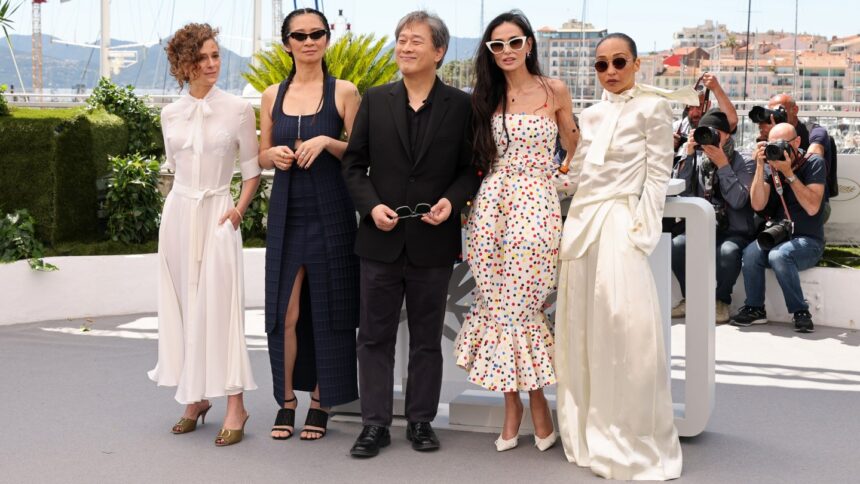
Hollywood star Demi Moore and Korean author Park Chan-wook opened the 79th Cannes Film Festival on Tuesday with a series of subtle but incisive statements defending the role of politics in cinema.
Asked if she had concerns that political statements during the festival might distract from the films themselves, Moore said she very much hoped that would not happen. “I think part of art is about expression, so if we start censoring ourselves, we shut down the core of our creativity, which is, I think, the place where we can discover truth and answers,” she said.
Park, who chairs this year’s Cannes jury, then offered an extended defense of political filmmaking in response to a similar question, which quickly became the dominant theme of the first Cannes press conference.
“I don’t think politics and art should be separated,” the South Korean author said. “I think it’s a strange concept to think that they are in conflict with each other. Just because a work of art makes a political statement, it should not be considered an enemy of art. At the same time, just because a film is not making a political statement, this film should not be ignored.”
But Park also noted that “the most intelligent political statement” could easily turn into “propaganda” if “it is not expressed skillfully enough.”
Park later added, “I am ready to watch films with the pure eyes of the audience, without any prejudice or stereotype, just the excitement of watching films that will surprise me.”
The comments came three months after this year’s 76th Berlin International Film Festival, where jury president Wim Wenders told reporters during the opening press conference that filmmakers “should stay out of politics because if we make ad hoc political films, we enter the realm of politics.” The comments sparked an immediate backlash online and helped spark one of the most acrimonious editions in the German festival’s recent history. The fallout included an open letter signed by more than 80 industry figures – including Javier Bardem and Tilda Swinton – criticizing the Berlinale for what they called its “silence” on the war in Gaza and the German Culture Ministry holding a meeting about the future direction of the festival.
This year’s nine-member Cannes jury features talent from the world of cinema. Moore joined Park. Academy Award Winner Chloe Zhao (Bedouin, Hamnet); Swedish veteran Stellan Skarsgård (Emotional value); French actor Isaac de Bancoli (Ghost Dog: Way of the Samurai); Irish-Ethiopian actress Ruth Negga (Loving); Belgian director Laura Wandel (For Adam’s sake); Chilean director Diego Cespedes (The mysterious look of a flamingo); and Scottish screenwriter Paul Laverty, a long-time collaborator of Ken Loach.
Later in the press conference, Moore was asked about the rise of artificial intelligence in filmmaking, and took a more nuanced stance. “AI exists, so fighting it means, to some extent, fighting a battle that we are going to lose,” she said. “So, I think finding ways that we can work with it is a more valuable path.” “Are we doing enough to protect ourselves? I don’t know. I’m inclined to say maybe not.” However, Moore said the technology has its limitations. “There are beautiful aspects of being able to tap into it, but the truth is that there’s really nothing to be afraid of, because what can never be replaced is the true art that comes from it, and it’s not the body. It comes from the soul. It comes from the soul of each and every one of us sitting here.”
Lafferty was the most outspoken of the Cannes jury on the festival’s opening day, offering a sharp critique of the industry’s embrace of artificial intelligence. The Scottish screenwriter claimed that industry and society in general should be deeply suspicious of the companies and tech billionaires who own and control the world’s most popular AI services, “because they decide which algorithms affect our lives most profoundly.”
“What seems absolutely unbelievable to me is that they assume that the rest of the world will follow suit and swallow it, whatever the consequences,” he continued. “Look at the whole crisis now in the data.” [centers] – Impact on sustainability, water and population. I think people are starting to realize that we shouldn’t let our tech brethren — billionaires who are mostly right-wing liberals — dictate the way we live our lives.
He continued: “What impact does this have on the workers – other than artists and ordinary workers – in our society and on our children? So we have to examine who owns it, and we have to demand, I think, that it be made transparent and more democratic. And it’s very important that we leave it to those people.”
Lafferty also shared his view on the value of cultural events like Cannes in a world increasingly torn by war and conflict. “When you see so much systemic violence – the genocide in Gaza and all these terrible conflicts – the idea of coming to a festival, which is a celebration of, you know, diversity and imagination and tenderness and nuance and beauty and inspiration – it shocks me, to be honest,” he said, adding: “I can’t wait to start the adventure with these amazing characters by my side.”
The Park jury will award the Palme d’Or to one of the 22 films in this year’s competition at the festival’s closing ceremony on Saturday, May 23. The seventy-ninth edition of the Cannes Film Festival opens on Tuesday evening with the world premiere of the romantic comedy film Roaring Twenties, directed by Pierre Salvadori. No electric venus.