


BENGALURU: A customer books a cleaner through an app. Worker arrival. But this time, there is a camera mounted on the worker’s head.The photo sparked widespread concern online after on-demand home services startup Pronto confirmed to TOI that a small subset of customers can sign up for a program where home jobs are recorded using visible head-mounted cameras worn by workers.
This issue gained attention after online portal Entrackr reported that an investor note linked the Pronto workflow to “Physical artificial intelligence” and robot training data. The pilot covers 0.1% of users and is intended for customers who feel uncomfortable about letting unfamiliar workers into their homes while they are away, said Anjali Sardana, co-founder and CEO of Pronto. “They are concerned about what happens in their home during confinement. Something may be stolen or broken, or the work may not be done properly.”
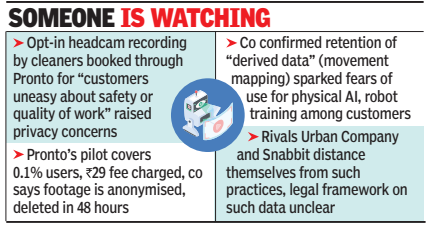
Pronto’s new investor, Lachy Groom, is also a co-founder of Physical Intelligence, an American startup that builds basic models of robotics. Pronto recently raised new capital from itself and others, doubling its value to $200 million in just a few months.She said the videos are anonymous, no audio is recorded, and the footage is deleted within 48 hours. But the company confirmed this “Derived data sets” Of those recordings are kept, incl “Mapping key points” Track data of body joints and hand movements.
When asked whether these data sets could eventually be monetized or shared with third-party AI or robotics companies, Pronto declined to comment.Customers who opt for this pay an additional Rs 29 per booking; Workers are also paid extra.Pronto’s clarifications did little to calm the backlash. On X, a post announces “Register inside your home for artificial intelligence training! This is scary” It attracted thousands of views and interactions. “Trust is the cornerstone of any business involving consumers or services and Pronto has just lost it,” another user wrote.
Others raised a more practical concern: that it is almost impossible to truly hide the identity of the homes. “Think name plates, ID cards, credit cards, bills,” A frequent user of the home services app told TOI.
Rival platforms moved quickly to distance themselves. “We are in the business of trust, and we take customer privacy seriously. We do not engage in any of these activities, have never done so, and have no plans to do so.” Abhiraj Bhal, co-founder of Urban Company, told TOI.
Ayush Agarwal, founder of Snapbit, said his company does not do any such activity either.Behind this debate there is a rapidly emerging market for “selfish,” Or first-person data used to train physical AI systems. Unlike text-trained chatbots, physical AI needs exposure to real-world environments such as kitchens, utensils, shelves, clutter, and repetitive human motion. Some AI labs globally are paying $4 to $10 an hour for this data, according to one founder in the field.The legal picture is still ambiguous. Nikhil Narendra, partner at law firm Trilegal, noted that anonymized household data could fall outside India’s digital personal data protection law, while warning that India still lacks a governance framework for non-personal data.For now, the front door remains the last line of privacy. The debate is about how long this will last.