MUMBAI: The Reserve Bank of India has opened the dollar tap by taking on currency risks itself to attract funds from abroad, while urging state-owned borrowers to look abroad for cheaper funds.The RBI will not charge any premium on swapping dollars raised through non-resident banks’ foreign currency deposits (b), which effectively absorbs the entire forex risk and allows banks to offer higher returns to non-resident Indians. In addition, three- to five-year FCNR(B) deposits will be exempt from the cash reserve ratio and statutory liquidity ratio, reducing the cost of mobilizing these funds for banks.The higher return on non-resident foreign currency deposits provides an arbitrage opportunity for NRIs – borrowing money from banks abroad and putting it in India and pocketing the difference in interest rates.
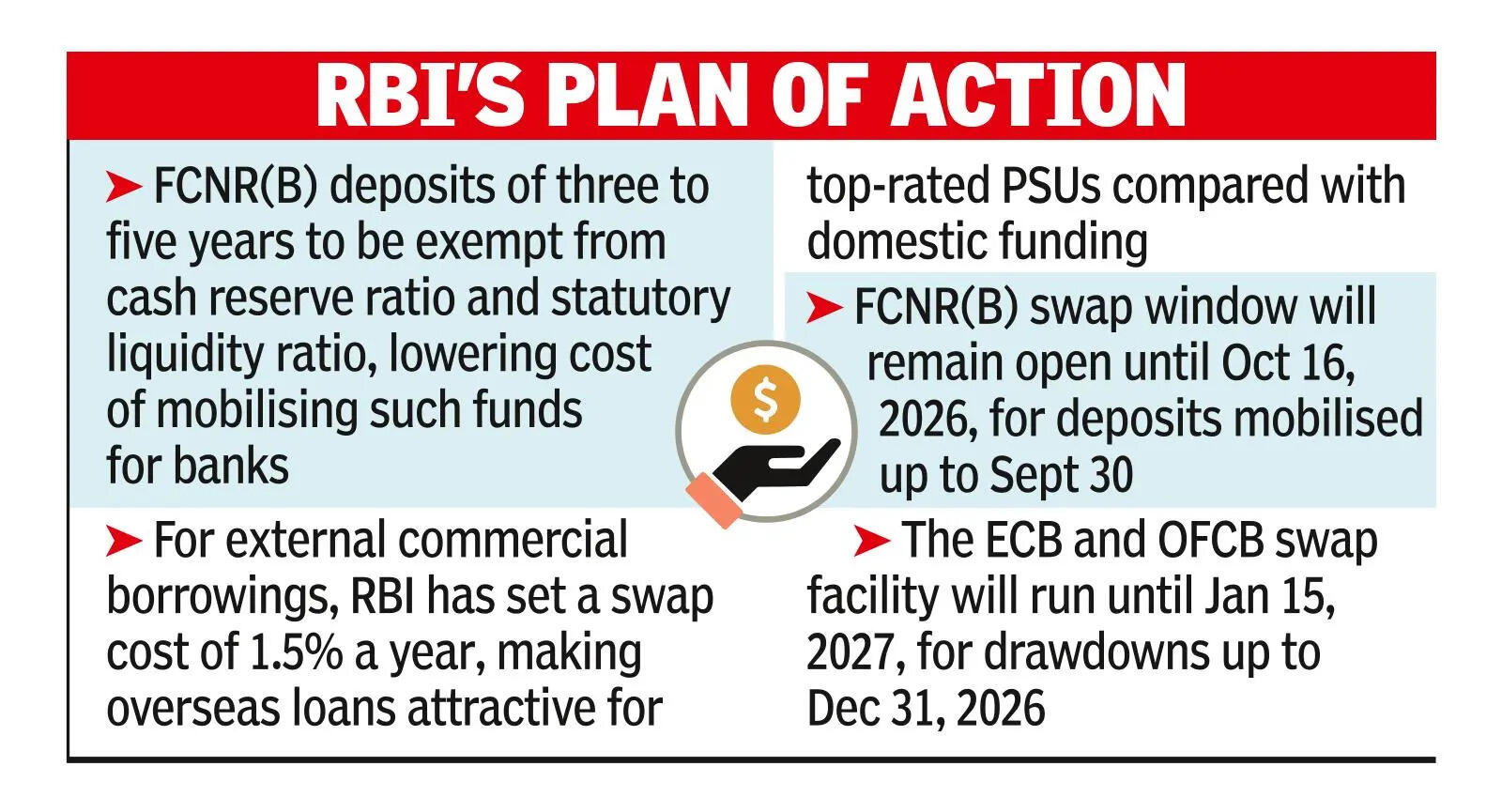
For external commercial loans, the central bank has set a swap cost of 1.5% per annum, making external loans attractive to higher-rated PSUs compared to domestic financing. Bankers expect flows of about $50 billion through the two schemes.The latest window also avoids regulatory restrictions that were tightened earlier this year. Dollar swap deals with the Reserve Bank of India will be kept outside the limits of net open positions, a move aimed at encouraging participation without falling within the balance sheet limits that were introduced to curb speculation in the forex market.
The FCNR(B) swap window will remain open until 16 October 2026 for deposits mobilized until 30 September, while the ECB and OFCB swap facilities will continue until 15 January 2027 for withdrawals up to 31 December 2026.RBI Governor Sanjay Malhotra on Friday said there is no target or cap on mobilization under these schemes, while clarifying that the ECB’s concessional swap window is limited to public sector projects. “The benefits of PSUs are passed on to the general public as they meet their utility and infrastructure needs more.
“If we expand to the private sector, the benefits will not be as widely distributed,” he said. Pricing mechanisms confirm the policy objective.
The RBI will charge a fixed premium of 1.5% per annum, doubling semi-annually, on swaps linked to ECBs and OFCBs. The Tier I authorized dealer banks will sell the dollars to the Reserve Bank of India (RBI) at the prevailing FBIL reference rate on a spot basis and, on maturity, will return the rupee funds along with the accumulated premium to buy back the dollars.The RBI has also given balance sheet relief to banks by allowing them to exclude swap positions arising from such transactions while calculating net open positions. According to the circular, this ensures that foreign currency exposures resulting from these multi-year swaps do not overlap regulatory limits under FEMA guidelines. Swaps will be irrevocable, and FCNR(B) deposits will carry a one-year lock on early withdrawal.