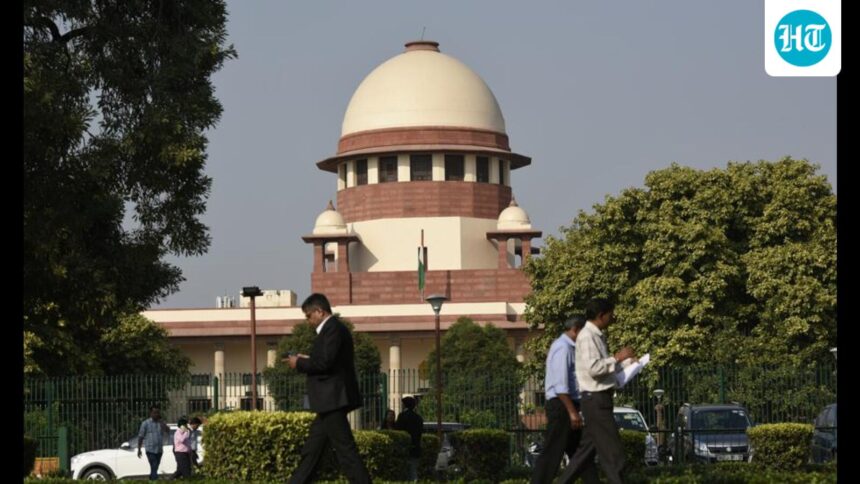
The Supreme Court on Monday termed the issue of unexpected fluctuations in air ticket prices and surcharges charged by private airlines as “serious” and asked the Union government to look into the issue and give a formal response.

A bench of Justices Vikram Nath and Sandeep Mehta said that fluctuation in air ticket prices and surcharges during festive seasons was a matter of “very grave concern” worthy of consideration under Article 32 of the Constitution.
The bench made the observation while hearing a writ petition filed by social activist S Laxminarayan, who sought regulatory guidelines to curb sharp and unpredictable variations in air ticket prices.
“This is a very serious concern. Otherwise we would not accept the Section 32 petition.” [for enforcement of fundamental rights]“, the bench observed, stressing that the matter deserves the attention of the court.
While appearing before the Union government, Additional Solicitor General (ASG) Anil Kaushik informed the court that the case was being heard at the “highest level” and that an affidavit would be filed within four weeks.
“The Solicitor General has also called a meeting. We have taken the matter to the highest level. We are in discussions with the highest authority. We may be given a deadline of four weeks. We will come up with a counter,” Kaushik said.
After taking note of the statement, the court adjourned the matter for further consideration to March 23. “Assistant Secretary General Anil Kaushik, representing the Federation, states that a period of four weeks will be given to the Ministry of Civil Aviation to file an affidavit after deliberation. This matter has been listed for March 23,” the order said.
When the Indian Airlines Association sought its inclusion in the proceedings, the bench refused to allow it at this stage. Noting that the executive would take the call first, the council noted: “The union will deal with you. They will contact you before taking the decision. They will form a committee and take the decision. It is up to the ministry. If they do not do that, we will look into that later.”
Senior advocate Ravindra Srivastava appeared for the petitioner, assisted by advocates Charu Mathur, Jay Cheema and Abhinav Verma.
The petition stresses that air travel is no longer a luxury but an essential service for millions, especially during emergencies, festivals and situations where rail and road transportation may not be viable. It argues that airlines deploy opaque, algorithm-based dynamic pricing systems that allow prices to change multiple times a day.
The petitioner claims that such systems disproportionately affect the poor and middle class, who often book tickets at the last minute due to necessities such as medical emergencies, death, tests, or sudden business travel.
The petition notes that air transport is recognized as an essential service under the Essential Services Maintenance Act 1981, putting it on par with railways and postal services. However, unlike sectors such as railways, electricity, or healthcare, airline pricing remains largely outside regulatory control.
According to the petitioner, airlines have gradually reduced free baggage allowances, from 25 kg to 15 kg in many cases, while charging high fees for excess baggage, effectively monetizing what were previously standard items. The absence of a regulator authorized to cap prices or regulate surcharges has enabled what the petition describes as unchecked profiteering.
The petition seeks directions to the Union government and the Directorate General of Civil Aviation to set binding standards on air fares, cap pricing during peak periods, regulation of baggage and other surcharges, standardization of cancellation and refund policies, and establishment of an independent aviation regulatory body with statutory powers to protect the interests of consumers.
During a hearing on January 21, the bench expressed concern over what it described as exploitative pricing, especially during major events like the Kumbh Mela. “Look at the exploitation you made during the Kumbh,” Justice Mehta said. “Not just Kumbh, but every festival,” Justice Nath added.
Justice Mehta observed: “Take the statistics for these two cities, Prayagraj and Jodhpur – air ticket prices are three times higher than those of pre-festival flights.”