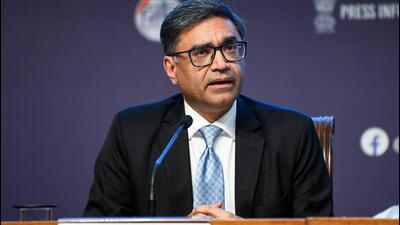
India will maintain multiple sources of energy and diversify them to ensure stability, align all purchases with national interest, Foreign Secretary Vikram Mishri He said this amid controversy over India’s halting of crude purchases from Russia as part of a trade deal with the US on Monday.
External Affairs Secretary Vikram Mishri said that India is not only one of the largest consumers of energy, but has also played an important role as a stabilizing factor in the global energy market (ANI).Misri is the first official after the US president to clarify this issue Donald Trump An executive order was issued in this regard on Friday Removed 25% punitive duty on Indian exports On the condition that New Delhi does not continue to buy Russian oil.
The hot-button issue, used by the opposition to criticize the government, was lobbied between the foreign and trade ministries.
The foreign ministry has long maintained that national interests and ensuring the country’s energy security are the main reasons for energy sources, and Misri reiterated this position when asked about buying Russian oil at a media briefing.
“Our approach is to maintain multiple sources of supply and diversify them as appropriate to ensure stability. So, I would say the more diversified we are in this area, the safer we are,” Misri said.
More Read
Business choices will be made based on considerations such as adequate availability, fair pricing, reliability of supply, risk and cost assessment, supply, internal accountability-related processes of oil companies and their fiduciary responsibilities, Misri said.
“What I can say strongly and confidently is that, whether it is the government or indeed our business, at the end of the day, the national interest will be the guiding factor for us in our choices,” he said.
“India is not only one of the largest consumers of energy, it plays an important role as a stabilizing factor in the global energy market. And this is one of the reasons why we import energy from multiple sources,” he added.
More Read

The Foreign Secretary, who was addressing the media during the President’s visit to Seychelles, agreed to resolve the issues that had been “flipping around for several days”.
Earlier, External Affairs Minister S Jaishankar said the Commerce Ministry was handling all matters related to the trade agreement with the US, while Commerce Minister Piyush Goyal said the External Affairs Ministry would provide details on the purchase of Russian oil.
Misri noted that India, which imports about 85% of its energy, is concerned about “potential inflation driven by energy costs”. The country’s main priority is to protect the interests of consumers and ensure they have access to “adequate energy at the right price and through reliable and secure supply,” and these objectives drive energy import policy, he said.
Significant uncertainty in the global economy in recent years has affected the stability of global energy markets and India and other countries “have a shared and common interest in ensuring stable energy prices and secure supply”, Misri said.
Noting that India imports crude oil from dozens of countries, he said: “We are not dependent on any single source for this, nor do we want to be. And it is normal for a mix of sources from time to time depending on objective market conditions.”
The comments indicate that India has no plans to reduce its oil purchases from Russia to zero, even as it has increased its purchases of oil and gas from the United States.

India, the world’s second-largest crude oil importer after China, has substantially increased its purchases of discounted Russian energy after the United States and its Western allies imposed sanctions on Russia over its invasion of Ukraine in 2022. Russian oil has risen from less than 1% of India’s crude basket to 35-40% in recent years.
New Delhi faced initial pressure from the West over these imports, even as the government claimed that the former Biden administration in the US was okay with the move as part of efforts to stabilize global purchases.
But India faced renewed pressure from the Trump administration last year, particularly after the president was frustrated by the lack of progress in efforts to end the war in Ukraine. After imposing a 25% punitive tariff on Indian exports, Trump and his close allies accused India of financing Russia’s “war machine”.
Last December, India’s oil purchases from Russia fell to a 38-month low, while December 2024 Energy imports from the U.S. rose nearly 31% in the same month, according to Rae’s figures. Russian oil has accounted for less than 25% of India’s imports in recent weeks.
Trump’s recent executive order states that “India has committed to stop importing oil directly or indirectly from the Russian Federation. [and] represents that it will purchase US energy products from the US”. Under the trade agreement, India is expected to buy US products, including energy and technology, worth $500 billion over five years.
The executive order also said that the US Secretary of State, along with other senior officials, would recommend additional measures, including reinstating the 25% punitive tariff, if India resumes importing Russian oil.