

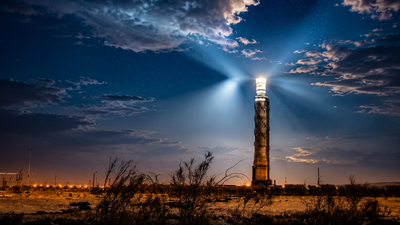
Rising above a vast expanse of Israel’s Negev Desert, the Ashalim solar thermal power plant has earned an unexpected nickname: the “Eye of Sauron.” The 240-metre-tall tower is topped with a magnificently glowing solar receiver that can be seen from kilometers away. It has been described as being visible from space, and bears a striking resemblance to the all-seeing eye from The Lord of the Rings.
However, this futuristic-looking landmark is not a military facility, but rather the centerpiece of one of Israel’s most ambitious renewable energy projects. Using about 50,000 computer-controlled mirrors, the facility focuses sunlight onto the tower’s receiver to generate electricity. The magnificent structure has become a showcase of Israeli architecture and a subject of fascination, local folklore and environmental debate.
Why was it called “Eye of Sauron”?
The nickname stems entirely from the appearance of the tower. Near the top of the structure is a large circular solar receiver that looks like a giant glowing eye, especially when lit up at night. The resemblance has led netizens to compare it to the fictional Eye of Sauron from J. R. R. Tolkien’s novel The Lord of the Rings, which according to the Tolkien portal is a symbol of the Dark Lord’s constant vigilance.
In its 2022 report on the project, The New York Times noted that some locals affectionately referred to it as the “second sun,” while others felt its constant glow made it resemble the ominous Eye of Sauron from J. R. R. Tolkien’s fantasy novels. The nickname eventually spread across social media and international news coverage. Unlike its fictional counterpart, the real Eye of Sauron is not a surveillance system at all.
Its purpose is to generate electricity. Thousands of computer-controlled mirrors continuously track the sun, directing its rays towards a receiver at the top of the tower, where the concentrated heat is converted into steam to operate electricity-generating turbines.
What does the tower actually do?
The tower is the centerpiece of the Ashalim Solar Thermal Power Plant, a concentrated solar power (CSP) facility that converts sunlight into electricity.
Instead of generating power directly through photovoltaic panels, the plant uses about 50,000 computer-controlled mirrors, known as heliostats, spread across the surrounding desert. Throughout the day, these mirrors continuously track the sun and reflect its rays towards a receiver installed at the top of the tower.Concentrated sunlight heats water in the receiver to produce high-temperature steam, which drives a turbine connected to an electricity generator.
When it entered service in 2019, the tower was approximately 240 meters (790 feet) tall, making it one of the tallest buildings in Israel and, at the time, the tallest solar tower in the world.
Why was it built in the Negev desert?
The Negev Desert was chosen because it provides some of the best conditions in Israel for generating concentrated solar power. The region covers more than half the country’s land area, receives abundant sunlight most of the year, has vast expanses of open land and relatively little cloud cover, all of which are necessary for a solar tower that relies on thousands of mirrors that reflect sunlight onto a single receiver.The Ashalim site also provided enough space to install about 50,000 heliostats, computer-controlled mirrors that constantly track the sun and focus its rays on the top of the tower. The flat desert landscape reduces vignetting between the mirrors and allows them to operate at maximum efficiency throughout the day.Besides its natural advantages, the project forms part of Israel’s broader strategy to expand renewable energy production and reduce dependence on imported fossil fuels.
The Ashalim complex was envisioned as a pioneering clean energy project that would help demonstrate Israel’s technological capabilities while generating about 310 megawatts (with other facilities), enough to power approximately 120,000 homes.
Its remote desert location also meant that a massive solar field and 240-meter-tall tower could be built with minimal impact on densely populated urban areas, although the glowing tower has since become an unmistakable landmark that can be seen from several kilometers away.
From record highs to unexpected environmental challenges
Upon completion of its construction in 2019, the Ashalim solar thermal plant was 240 meters (about 790 feet) tall, making it the tallest solar tower in the world. It has since been surpassed by Noor Energy Tower 1 in Dubai, which reaches a height of 260 meters (about 850 feet), making Ashalim the second tallest solar tower in the world. The project has also drawn attention to unintended environmental consequences. According to the New York Times, locals reported that birds sometimes flew through the concentrated beams of reflected sunlight and were fatally burned before falling to the ground.
The accident sparked controversy about the environmental impact of concentrated solar power plants, especially on bird populations.
A landmark praised by some and questioned by others
While the Ashalim Tower is widely recognized as a remarkable engineering feat, it has not been without controversy. Supporters see it as a demonstration of Israel’s renewable energy ambitions and an important step toward reducing dependence on fossil fuels. However, critics argue that by the time the project was up and running, traditional solar PV panels had become much cheaper, raising questions about whether such an expensive concentrated solar power system remains the best investment.
The New York Times also reported that some residents living near the tower described its magnificent reflection as both mesmerizing and devastating, turning the structure into a daily presence in village life.