

Computer: W.M. Keck Observatory
For decades, dark matter has been treated as the invisible framework around which galaxies form. It is generally believed that even the smallest galaxies are enveloped in vast halos, with invisible matter outshining stars by a large margin.
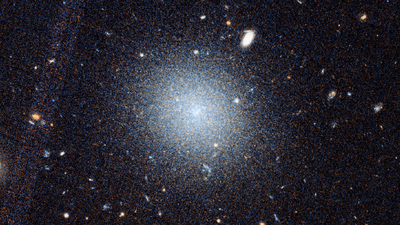
This assumption has previously been challenged by two faint galaxies known as DF2 and DF4, both of which appear to contain much less dark matter than expected. Now a third object has joined that unusual group. The galaxy, called DF9, appears to be missing dark matter as well. Even more interesting is that it lies along the same narrow chain of galaxies as the other two, reinforcing the idea that all three were born from a single catastrophic event that separated ordinary matter from its dark counterpart.
How did scientists discover the lack of dark matter? Galaxy DF9
According to the study published in the Astrophysical Journal, titled “A third galaxy is missing dark matter along the path of galaxies in the field of NGC 1052,” using observations from the W.M. Keck Observatory in Hawaii, the team examined DF9, a faint, diffuse galaxy located in the region of NGC 1052. Their measurements suggest that the galaxy’s mass can be explained almost entirely by the stars it contains, leaving little room for the dark matter that should normally dominate a system of its size.
What makes the DF9 particularly interesting is its location. It is not an isolated anomaly. The galaxy lies on the same remarkably straight path of low-luminosity galaxies that already include DF2 and DF4. Previous work has shown that galaxies along this path also share a coherent motion pattern, suggesting that they may have arisen together rather than forming independently over billions of years. According to the research team, this discovery adds weight to the idea that the entire structure arose from a common event and not from a chance alignment.
How did astronomers measure the missing dark matter in DF9?
Dark matter cannot be observed directly, so astronomers infer its existence through gravity. A galaxy with large amounts of dark matter should exhibit stars moving faster under the influence of that hidden mass.To investigate DF9, researchers used the Keck Cosmic Web Imager (KCWI) on the Keck II telescope. By analyzing subtle shifts in starlight, they measured how fast stars were moving within the galaxy. The result was unexpectedly low.The team calculated that DF9’s mass contains approximately 100 million times the mass of the Sun, which closely matches the amount expected from its visible stars alone. If DF9 has a typical dark matter halo, its total mass should be about a hundred times greater.According to the WM Keck Observatory, dark matter dominates almost every known galaxy, while DF2, DF4 and now DF9 appear to be rare exceptions. He added that the results provide some of the strongest evidence to date that the three galaxies formed together during a violent event that separated ordinary matter from dark matter.
How high-speed collision created galaxies devoid of dark matter
The idea that receives the most attention is sometimes described as the “lead dwarf” scenario. In this image, two gas-rich dwarf galaxies collide at extremely high speed. During the collision, ordinary gas would be stripped of the surrounding dark matter halo.This displaced gas may have condensed to form new galaxies that contain stars, but very little dark matter. Computer simulations have already suggested that such collisions could produce long chains of galaxies similar to those observed around NGC 1052.The newly measured properties of DF9 are surprisingly consistent with this prediction. Before studying the galaxy in detail, the collision model predicted that other members of the path should also show a lack of dark matter if they formed from the same separate gas cloud.According to the study, the result provides strong evidence that dark matter behaves as real physical matter rather than just an effect produced by alternative theories of gravity.
He pointed out that dwarf galaxies are among the most important places in which such competing ideas are tested.
Astronomers continue to investigate the mystery of DF9
Astronomers remain cautious. NGC 1052’s path is unlike anything previously observed, and questions remain about exactly how the system formed. Alternative explanations involving tidal interactions or material released during galaxy encounters are also discussed.However, the discovery of a third dark matter-deficient galaxy changes the picture.
One unusual galaxy may be dismissed as an anomaly. Two raised eyebrows. Three connected objects that share the same structure and behavior indicate a broader physical process.Future observations will focus on searching for residual gas associated with the ancient collision and examining remaining galaxies along the path. Many of them are fainter than DF9, making them difficult targets, but they could reveal whether the entire series shares the same unusual characteristics.For now, DF9 represents the latest evidence that galaxies can sometimes form in ways that astronomers rarely, if ever, expected. In a universe where dark matter usually seems to be an integral part of galaxy formation, this strange line of galaxies suggests that, under the right conditions, the two could be separated from each other.