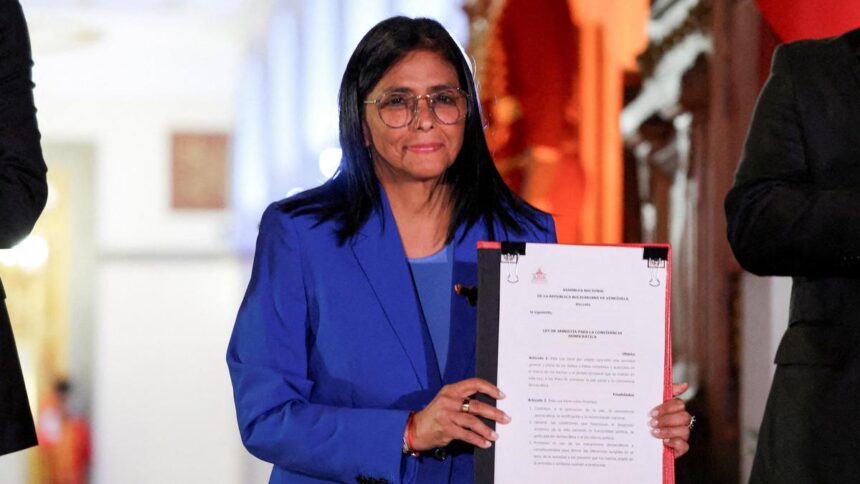
Venezuelan authorities have granted amnesty to 379 political prisoners, a lawmaker said on Friday (Feb.
Venezuela’s National Assembly unanimously approved the law a day earlier, raising hopes that hundreds of political prisoners will soon be freed.
National Assembly Deputy Jorge Areza, the lawmaker overseeing the amnesty process, said in a televised interview on Friday (February 20) that 379 prisoners “should be released, granted amnesty, between tonight and tomorrow morning”.

“Requests are submitted by the public prosecutor’s office to competent courts to grant amnesty measures,” he said.
Opposition figures have criticized the new law, which includes carveouts for some crimes that authorities have previously used to target Mr. Maduro’s political opponents. It clearly does not apply to those prosecuted for “promoting” or “facilitating… armed or coercive actions” against Venezuelan sovereignty by foreign actors.
Acting President Delsey Rodriguez made such accusations against opposition leader Maria Corina Machado, who is expected to return to Venezuela at some point from the United States. The law also exempts members of the security forces involved in “terrorism” related activities.
Most of us know that the amnesty law does not apply to our relatives,” said 39-year-old Hiovanka Avila. AFP Outside the Rodeo 1 prison near Caracas, many of those detained are ex-soldiers or officers.

Her brother Henriberth Rivas, 30, was arrested in 2018 for allegedly participating in an assassination attempt on Mr Maduro using armed drones. Mr. Arreaza said earlier.
A long wait
Relatives of many prisoners across Venezuela have been waiting outside prisons for weeks for their loved ones to be released. Hundreds have already been granted conditional release by the government of interim President Delsy Rodriguez since the deadly US raid that captured Mr Maduro.
The NGO said 650 people were detained before the announcement of the forum, and the toll has not been updated since then.
Alfredo Romero, director of the Foro Penal, said on Friday (20 February) that “amnesty does not happen automatically” but required a process in the courts, which many attributed to Mr Maduro’s crackdown.
President Rodríguez defended her government in a speech on state television on Friday (February 20, 2026) saying “we are building a more democratic, more just and free Venezuela, and it must be with the efforts of everyone.”
‘Totally Free’
Opposition politician Juan Pablo Guanipa, an ally of Mr. Machado, announced his release from detention shortly after the bill was passed.
He was released from prison earlier this month, but was soon rearrested and placed under house arrest. “I am now completely free,” Mr Guanipa wrote on social media.
He called for the release of all other political prisoners and the return of exiles. Earlier on Friday (February 20, 2026), he held a rally with supporters in his hometown of Maracaibo, Venezuela’s second city.
The law has drawn criticism from rights groups over its potential use to condone abuses under Mr Maduro and his predecessor, Hugo Chavez.
Ousted Venezuelan opposition leader Edmundo González Urrutia said on Friday (Feb 20, 2026) that “there can be no lasting reconciliation without memory or responsibility” in his country.
“Responsible amnesty is a shift from fear to the rule of law. It is a pledge that power will never again be exercised without limits and that law will prevail over power,” Mr. Gonzalez wrote in Urrutia X.
Exiled in Spain, Mr. González Urrutia was widely considered the rightful winner of the 2024 presidential election, which Mr Maduro was declared the winner of amid allegations of fraud.
Hundreds, perhaps thousands, of Venezuelans have been jailed in recent years over actual or imagined plots to overthrow the Maduro government, taken to New York for trial on drug-trafficking and other charges.
Ms. Rodriguez was previously Maduro’s vice president and took his place as the South American country’s leader with the consent of US President Donald Trump, who has stuck to Washington’s line. The US has taken control of Venezuela’s oil sales, with Mr Trump promising Washington a share of the profits.