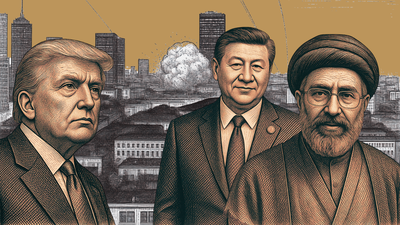
China and Iran are increasingly using global supply chains and strategic chokepoints to confront the United States, reshaping economic warfare and exposing Washington’s vulnerabilities, according to a report from The Washington Post examining how, when, where and how much these tactics are emerging in today’s shifting geopolitical landscape.The report argues that the United States is no longer the only power capable of taking advantage of economic choke points.China has used its dominance of rare earth minerals, which are critical to civilian and military technologies, to retaliate against US tariffs by restricting exports. This move surprised US President Donald Trump, with the president describing it as a “real surprise” on social media last April.
He watches
Shocking information: China is accused of strengthening Iran’s air defense amid fears of the collapse of the talks
At the same time, Iran has tightened its grip on the Strait of Hormuz, a vital global oil transit route, effectively disrupting energy flows.
The closure led to a rise in global oil prices and contributed to a ceasefire in the six-week conflict between the United States and Israel.“It turns out that the United States does not have all the choke points,” said Henry Farrell, co-author of “Underground Empire.” “We are in a world where the United States simply cannot get away with the things it thought it could get away with.”
The domestic impact hits American consumers
The economic repercussions extended directly to American families.
Fuel prices rose, with gasoline exceeding $4 per gallon, while disruptions in the Strait of Hormuz rippled through supply chains. The report pointed to rising costs of commodities such as fertiliser, aluminium, plastic and even mattresses.Food prices were also affected. Fresh Del Monte’s chief operating officer warned of a sharp increase in production costs, including for bananas, driven by rising diesel prices and the rising cost of plastic resins sourced from the Middle East.
Washington is under fire for not being prepared
The report highlights the criticisms directed at the US administration’s response to these developments.Senator Ron Wyden said the Treasury Department failed to assess the potential consequences to the energy market as a result of the conflict involving Iran. Citing Wyden, the report noted that Sriprakash Kothari, who had been nominated to become Assistant Secretary of the Treasury for Economic Policy, told committee staff that “not only had he not done any work related to energy markets leading up to the war, but he was not aware of anyone at the Treasury Department who had done so.”
“The lack of anticipation has raised concerns about Washington’s ability to respond to rapidly developing economic threats.
The end of the “good” global economy
Experts say that these developments represent a structural shift in the global economic system.“The global economy was designed for the benign environment of the 1990s, when we assumed China and Russia would be our friends,” says Edward Fishman, author of Choke Points. “But we live in a period of increasingly intense geopolitical competition.”Trade interdependence, once seen as a stabilizing force, is now seen as a weakness. The supply chains that have fostered globalization are increasingly being used as tools of pressure.
The race to build economic defenses
In response, major economies are moving to isolate themselves.The United States, China and Europe are investing in domestic production of critical goods and diversifying supply chains to reduce dependence on geopolitical rivals.
US Secretary of State Marco Rubio warned that reliance on foreign supply chains may limit Washington’s strategic options.“There is virtually no leading industry in the 21st century in which we do not face some level of vulnerability, and it has become one of the highest geopolitical priorities we face now,” Rubio said.
A shifting global landscape
The report concludes that while China’s dominance in areas such as rare earths may gradually decline as the United States ramps up domestic mining efforts, the broader shift is irreversible.“This process will continue until you have a new global economy,” Fishman was quoted as saying.As countries race to build economic resilience, the era of interdependence as a guarantee of stability appears to be giving way to an era that can be used as a strategic weapon.