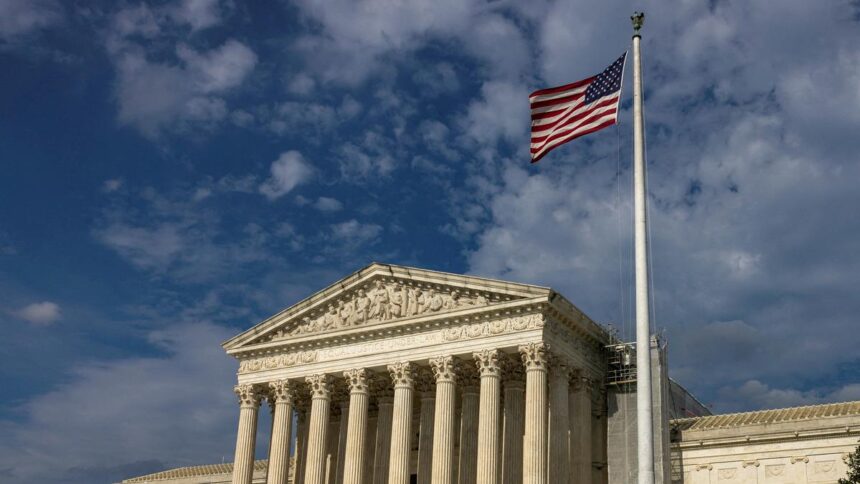

A view of the US Supreme Court in Washington. file | Photo credit: Reuters
The US government sought to reimpose the tariffs struck down by the nation’s Supreme Court by enacting a different law. But a Supreme Court ruling dealing with tariffs imposed by President Donald Trump’s exercise of emergency powers strikes at the root of his unilateral decision to impose tariffs. He needed congressional approval, reinforcing the central tenet of the US governance model and public life – checks and balances and seeking consensus.
The US Supreme Court rejected the tariffs outright India to face 10% lower tariffs after Trump’s announcement on new tariffs effective February 24
Shortly after assuming power, Mr. Trump sought to address two “foreign threats”: the flow of illegal drugs from Canada, Mexico and China, and “large and persistent” trade deficits. Mr Trump has cited both and declared a national emergency and imposed tariffs to counter each threat.
The court called the case a “main question” case and applied the main question doctrine because only the US Congress has the power to impose tariffs. Section 8 of the US Constitution states: “Congress shall have power to lay and collect taxes, duties, imposts, and excises.” The Constitution makers gave that power only to the Congress,” the court said.
The principle of checks and balances may apply in democracies, but in the US safeguards are more effective and prioritized. Checks and balances are meant to ensure that no one gets “tyrannical” power. Autocracy — by the King of England — is the main reason the USA and its Constitution were founded, and US public life is built against tyranny. Strong, independent institutions are a feature of US life. Laws ensure consensus and constant communication, often requiring bilateral cooperation, even solidarity.
For example, the US Congress – the equivalent of the Indian Parliament – makes all the laws, not the President. But Congress is a permanent body and independent of the President. It is dominated by a different party than the president. The President has certain powers such as emergency powers and, more importantly, veto power over any law passed by Congress. The president, by definition, is a popular leader and as a result Congress is often loathe to go against him or her. Everyone needs to work together.

Mr. Since taking office, Trump has been able to defeat his party’s majority Congress, as moves such as tariffs and actions on Venezuela have been popular with the general public, despite complaints from some businesses. His administration focused on using the letter of the law rather than intending to rule by executive fiats. The Supreme Court said: “Since the imposition of each set of tariffs, the President has issued several increases, reductions and other changes.” The court said Mr Trump had issued “shocking amendments at will”. And the Supreme Court has acted against this “at will” attitude.
Both domestically through foreign policy and by going after its political opponents or trying to settle scores, the Trump administration has adopted a take-no-prisoners approach. Rules are thrown to the wind. Government personnel, including government lawyers trained to be rule-abiding and independent, were fired if they did not do his bidding. Action against Venezuela is only the most visible foreign policy manifestation of this approach. And the US Supreme Court belled the cat, it seems.
The implications of the court’s ruling apply not only to tariffs but also to the president’s powers and conduct. As the tax cuts fill a significant hole in the US budget, the question that needs to be addressed is how the duties collected will be refunded to American businesses. Countries around the world, including India, will benefit from lower tariffs. Meanwhile, Mr. Trump abused Supreme Court justices, calling them “idiots and lapdogs” — unprecedented in US public life.

Although the US government says it has other powers at its disposal to bring back the tariffs, the Supreme Court’s ruling is certainly a setback. The Trump administration’s enthusiasm has been tempered, it seems. And it may affect the zeal with which the US government acts in other areas, including immigration.
The US Supreme Court is a constitutional court, not a court of appeals. So it is a case to investigate is selective about and it differs from the Supreme Court of India. The Court decided that tariffs were a “prime question” and that only Congress could rule on major questions. “Applying the dominant question doctrine also has implications for immigration cases. Even if courts uphold a $100,000 fee on an H1B, for example, plaintiffs can now argue more forcefully that the immigration or H1B fee has a foreign policy effect,” said immigration attorney Cyrus Mehta.
Published – February 21, 2026 12:40 pm IST