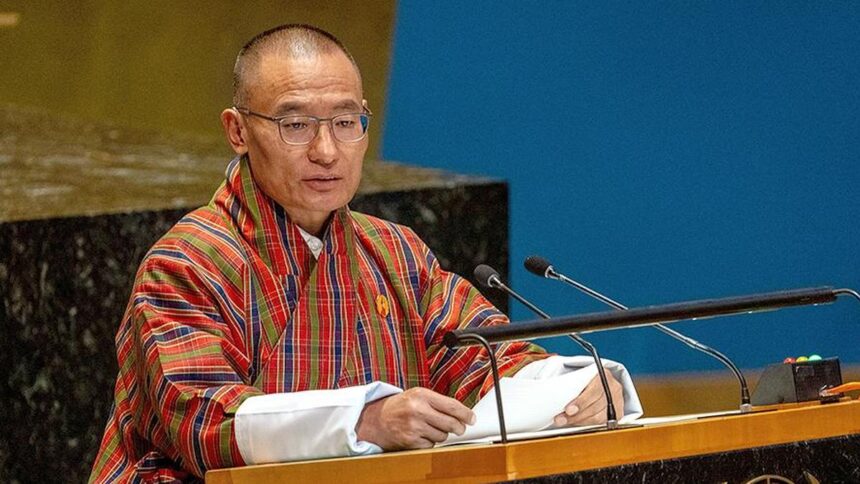

File photo of Bhutan Prime Minister Tshering Tobge | Photo credit: Reuters
Artificial intelligence (AI) should be a tool for humans, not a replacement for humans, it says Prime Minister of Bhutan Tshering Tobgesounding the alarm about the need for ethics and safeguards in an industry dominated by the US and China in 70% of products and research. In an interview with The Hinduspeaking at the AI Impact Summit Plenary Session for Leaders, Mr. Tobge also made a pitch for Gelefu Mindfulness City as a technology hub in the region, using India-Bhutan cooperation on hydropower for energy needs.
 You are here for the AI Impact Summit in India and Bhutan is also a guest of many. But at the end of the day, only two countries dominate the AI industry today, the US and China. Is there a place for other countries to have a voice?
 Under the leadership of Prime Minister Narendra Modi, 1.4 billion Indians are, dare I say it, more than a space. I know India has the ambition and tenacity to pull it off and lead [the sector] A lot.
This is not only for India but also for other countries. Switzerland will be the next host of the AI Impact Summit and Bhutan will, possibly, in the future. But can all the other countries that haven’t yet developed AI models play catch up? The rules are already being set by the two major superpowers…
Hence, all the more reason for India to work harder, faster and lead the pack.
How does Bhutan view AI? Is it seen as a tool?
I hope AI remains a tool. I hope that the big powers, the US, China and India will see that it is a tool, a good tool, an effective tool, a tool like no other. But I hope it remains a tool. In the wrong hands, this tool can be overkill or misused. So we need ethics, we need values. We need control. We need supervision. What we need, as Prime Minister, Modi has declared transparency, he wants a glass box, not a black box.
Are you optimistic about new synergies between India and Bhutan when it comes to AI, especially since creating AI requires a lot of electricity?
Yes and development cooperation between India and Bhutan has been highly successful in this region. It has been successful in a wide range of ways, but most successful in harnessing clean and green energy from Bhutan’s hydropower. Even as we speak, we are expanding our collaboration there and have ambitious targets to develop something like 25 gigawatts in the next 15 years. We are working with the Government of India. We are working with private companies in India and are going to use that energy exclusively for technology development. Much of our artificial intelligence development is going to take place in Gelefu Mindfulness City (GMC), which was established by His Majesty the King (Jigme Khesar Namgyel Wangchuck, Fifth King of Bhutan) as a special administrative region on the border with India. So, yes, we can do a lot together.
It has been two years since it started [Bhutanese] The king announced a plan for Gelefu. How did it progress? Now the airport has…
Galefu always has an airport, but it is a domestic airport. That domestic airport now operates international flights to India and an international airport is under construction. For that airport, conceptual drawings based on His Majesty’s vision have already been completed by a world-renowned architect and his firm. Gelefu Mindfulness City is going to become the center of Vajrayana Buddhism, and many monasteries and universities and meditation centers, retreat centers will be built and a lot of infrastructure is already coming up. The old town is being transformed and will be upgraded to provide the necessary space to work. More importantly, the soft part, all the laws are in place. The GMC has its own board and authority, has its own governance structure and is already operational. Many businesses have expressed interest. Tata Consultancy has an office in GMC, Tata Power is doing a lot of work, Adani Power is working a lot in developing energy, but also has a base in Galefu. And we have many “founding members” for GMC (including Gautam Adani), and we hope to get more founding members from India.
During the Covid pandemic, Bhutan emerged as a crypto power. Are you looking for more outsourcing, high tech, artificial intelligence, quantum computing space at GMC?
Look, at GMC we have consistency. We are Indian There is proximity. We have good friendship with India. We have Prime Minister Modi’s personal support for Galefu Mindfulness City. We have access to huge amounts of clean and green energy. We have a clean and stable and livable area, so we can do a lot together in the technology space.
However, the GMC was set up with a larger ambition to bring jobs to Bhutanese, especially the youth. India also has such a large population and manpower. How do you deal with the concern that artificial intelligence will take away jobs and not produce more?
Well, the obvious answer to that is to do more and more work on artificial intelligence. Jokes aside, there are jobs, high jobs. As long as tools are tools, you need people to handle the tools. If the day comes when tools don’t need human masters, we’re in trouble, and that’s a whole lot of discussion. If artificial intelligence can replace people en masse, we have reached a very dangerous tipping point.
Is building a global organization for governance a solution?
Every leader at the AI Summit expressed the need for gatekeepers. They all expressed the need for ethics and values and transparency and equity even when it comes to enjoying the benefits of AI. And every leader I’ve heard from has expressed concern about the lack of regulation, control, oversight. So if politicians are so concerned and apply action to their concerns, we should be able to control how AI develops. I believe that India is ready to provide that leadership in moderate terms, because India is the seat of the world’s most ancient knowledge, ancient civilizations. I think this technology can get out of hand if we ignore the ancient wisdom.
Published – February 21, 2026 12:43 pm IST