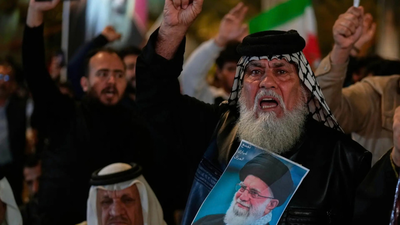
A joint and coordinated attack on Iran by the US and Israel eliminated the high-value target of Donald Trump’s Operation Epic Fury, killing Tehran’s Supreme Leader Ayatollah Ali Khamenei after the US president repeatedly called for “regime change” in the Islamic Republic.
But whether this goal will now be achieved remains uncertain.
A Washington Post report says a regime change transition in Iran remains “unlikely.”According to a confidential report cited by The Washington Post, even a large-scale US military attack on Iran is unlikely to topple the country’s entrenched military and religious establishment, casting doubt on prospects for regime change at a time when Donald Trump’s administration signals a broader military campaign that officials say is “just getting started.”
The report, which three people familiar with its contents confirmed to The Washington Post, casts doubt on President Donald Trump’s plan to “purge” Iran’s leadership and install a new ruler of his choosing.The intelligence assessment was completed about a week before the United States and Israel went to war on February 28. The assessment examined various scenarios, including a limited campaign targeting Iran’s leaders and a broader attack on the country’s leadership and institutions.
In both cases, analysts concluded that the Iranian regime would likely continue to operate even if Khamenei was killed. They said that Iran’s religious and military institutions have put in place measures to ensure continuity of power.The report also described the possibility of Iran’s divided opposition seizing power as “unlikely,” according to people familiar with the confidential document.The National Intelligence Council, which prepared the report, includes experienced analysts from across the US intelligence community.
Its reports are intended to reflect the collective judgment of the 18 intelligence agencies in Washington.The CIA referred questions to the Office of the Director of National Intelligence, which declined to comment. The White House also did not confirm whether Trump was briefed on the assessment before approving the military operation. Since the start of the war, the scope of the conflict has expanded, including submarine activity in the Indian Ocean and missile confrontations near NATO member Türkiye.“President Trump and the administration have clearly defined their goals regarding Operation Epic Fury: to destroy Iran’s ballistic missiles and production capacity, destroy its naval forces, end its ability to arm proxies, and prevent them from ever obtaining a nuclear weapon,” White House spokeswoman Anna Kelly said in a statement. “The Iranian regime is being completely crushed.”Other major media outlets, including the New York Times, Reuters and the Wall Street Journal, reported that US intelligence agencies doubted the Iranian opposition’s ability to quickly seize power.
However, the specific analysis conducted by the National Intelligence Agency on the likely outcomes of various military attacks has not been previously reported.Susan Maloney, an expert on Iranian affairs and vice president of the Brookings Institution, said that the assessment reflects a deep understanding of the Iranian political system.“It seems like a very informed assessment of the Iranian regime and the institutions and processes that were established many years ago,” she added.The intelligence report does not appear to have considered other potential options, such as deploying US ground troops in Iran or supporting ethnic Kurdish groups to foment an insurgency. It is also unclear whether the large-scale operation discussed in the report is exactly the same as the military campaign now underway.Meanwhile, Iran’s succession process appears to be unfolding even as the country faces intense air and naval strikes by the United States and Israel.The decision on Iran’s next supreme leader rests with the powerful Assembly of Experts, a high-level clerical body. However, members of the Islamic Revolutionary Guard Corps and other security officials also wield significant influence.There has been speculation that Mojtaba Khamenei, the son of the late Supreme Leader, might take power. But no official announcement has been made. According to a Western security official, the Iranian Revolutionary Guard is pushing his candidacy, although some prominent figures – including Ali Larijani, secretary of Iran’s Supreme National Security Council – have opposed the move.As the war entered its second week, Trump continued to demand Iran’s “unconditional surrender,” he wrote in a post on Truth Social. He also suggested he could play a role in choosing Iran’s next leader.Trump told reporters that Mojtaba Khamenei was “incompetent” and “a lightweight,” and said he did not want leaders who would simply “rebuild” Iran’s nuclear and missile programs.“We want them to have a good leader. We have some people who I think will do a good job,” he told NBC News.Iranian Parliament Speaker Mohammad Bagher Qalibaf rejected the idea that Trump would have any role in choosing the country’s next leader.The fate of our dear Iran, which is more precious than life, will be determined only by the proud Iranian people, and not by them [Jeffrey] Epstein gang,” Ghalibaf wrote on X, referring to the late sex offender who was close to Trump.Current and former US officials say they have not yet seen signs of a mass uprising inside Iran or serious divisions within the government or security forces that could lead to regime change.
In the past, Iranian security forces have demonstrated their willingness to suppress protests by force. During the demonstrations that broke out earlier this year over the country’s economic problems, thousands of demonstrators were killed.So far, Trump’s message to the Iranian people has been to stay home until the US-Israeli bombing campaign ends.Experts say that as long as Iran’s religious and military leadership remains intact, Trump will have limited influence on the country’s political future.“Kneeling to Trump would go against everything they stand for,” said Holly Daggers, a senior fellow at the Washington Institute for Near East Policy. “The upper echelons of the religious establishment are ideological, so their modus operandi is to resist US imperialism.”Trump may be able to influence events if the Iranian government collapses. But the intelligence report indicates that the regime is still strong.“There is no other force within Iran that can confront the remaining power that the regime possesses,” Maloney said. “Even if they are not able to effectively project that power against their neighbors, they are certainly capable of dominance within the country.”