

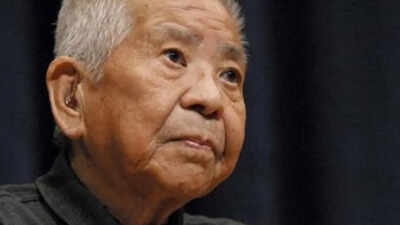
It is known that Tsutomu Yamaguchi is the only person who survived the two atomic attacks on Japan during World War II. His case has been documented in the history books and stands out as an unusual survival case associated with nuclear war.
The atomic attacks on Hiroshima and Nagasaki in August 1945 destroyed and killed hundreds of thousands of people. Although many people survived one attack, it was Tsutomu who lived in both cities when the explosions occurred and became one of a kind. His personal story shows how things happened during that period and how nuclear war affected people.
Hiroshima Atomic Bombing: Tsutomu Yamaguchi’s Survival During the First Nuclear Attack
On August 6, 1945, the city of Hiroshima was hit by the first atomic bomb used in war.
Tsutomu Yamaguchi was in town on a business assignment with Mitsubishi Heavy Industries. As he prepared to leave, he saw a military plane, later known as the Enola Gay, flying overhead. The bomb, known as “Little Boy,” exploded approximately 579 meters above the ground. The explosion released intense heat, radiation and a powerful shock wave.
Large parts of the city were destroyed within moments. Yamaguchi suffered burns and temporary loss of sight but survived the initial explosion.
He took shelter and stayed in Hiroshima overnight.
Return trip to Nagasaki and early recovery
On August 7, despite his injuries, Yamaguchi began returning to his home city. The transportation systems were partially operational, allowing him to complete the journey. He arrived in Nagasaki on August 8 and met his family. The physical condition of survivors varied during this period, with many suffering injuries and early effects of radiation exposure.
Yamaguchi informed his colleagues of his experience shortly after returning to work.
The second atomic explosion in Nagasaki and official recognition
On August 9, 1945, Nagasaki was targeted by a second atomic bomb. While at his workplace, Yamaguchi witnessed another airburst. The bomb, named Fat Man, contained plutonium-239 and produced an explosion equivalent to about 20 kilotons of TNT. The explosion caused widespread destruction in the Urakami Valley and surrounding areas.
Thousands of people were killed instantly, and many later died from injuries and exposure to radiation.
Yamaguchi survived this second explosion as well, despite being inside the affected area.In the years following the war, Japanese authorities documented survivors of the atomic bombing under the classification of hibakusha. These records included individuals who were exposed to radiation and the effects of the explosion in Hiroshima or Nagasaki.
In 2009, Tsutomu Yamaguchi was officially recognized as a “Nigo Hibakusha,” referring to the person affected by the atomic bombings. While historical records suggest that there may have been other individuals in both cities during the relevant period, Yamaguchi remains the only officially recognized individual in this category.
Life after atomic bombings: Tsutomu Yamaguchi’s role in nuclear education and awareness
Yamaguchi resumed his professional career and was also involved in educational work after the war. Later, he took up his job at Mitsubishi Heavy Industries again. Eventually, he began participating in public discussions on nuclear disarmament. As an older man, he addressed people from all over the world, including UN delegates. Yamaguchi’s speeches concern the long-term effects of nuclear bombs and the need to prevent such cases in the future.
Yamaguchi’s life story has been used as evidence in studies devoted to the problems of radiation exposure, as well as in describing the period of World War II.