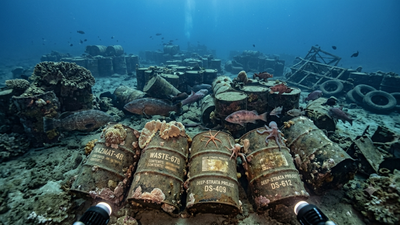
Four kilometers below the surface of the Atlantic Ocean, out of reach of sunlight and far from shipping lanes, lies a forgotten chapter of the nuclear age.More than 200,000 barrels of radioactive waste are spread across a vast area of the seabed.
They were lowered into the ocean over several decades during the second half of the 20th century, at a time when deep-sea disposal was widely viewed as an acceptable solution to a growing problem.
Once the barrels disappeared beneath the waves, interest largely moved elsewhere.Now scientists are going back. Using autonomous underwater vehicles capable of operating in some of the deepest parts of the ocean, an international team is beginning the most detailed investigation yet into these underwater waste disposal sites.
Their goal is not only to locate the barrels, many of which have never been accurately mapped, but also to understand how they have changed after decades on the seafloor and whether they are affecting one of the least explored ecosystems on Earth.The mission could finally shed light on a question that has remained unanswered for more than 30 years: What happened to the radioactive waste the world left behind?
The Atlantic Ocean became a waste-filled place during the early nuclear age
Long before climate change and plastic pollution dominated environmental discussions, governments faced another challenge: what to do with the increasing amounts of radioactive waste produced by research laboratories, hospitals and the rapidly expanding nuclear industry.
The solution that many countries have now settled on seems astonishing. Beginning in 1946, radioactive waste was packed into steel drums, often mixed with concrete or bitumen, loaded onto ships and transported offshore. The chosen destination was the far north-east The Atlantic Ocean, where its vast water depths and geographic isolation are thought to provide a natural barrier between waste and human populations.According to the French National Center for Scientific Research (CNRS), disposal operations have continued for decades.
In 1967 and 1969, more than 46 thousand barrels were dumped. There was nothing illegal about these discharges on the high seas, in international waters where no regulations apply. Thus, all the barrels were eventually deposited on abyssal plains more than 4,000 meters below sea level.At the time, scientists had only a limited understanding of deep ocean ecosystems. The seafloor was often viewed as a largely barren environment, and concerns about long-term environmental consequences received much less attention than they do today.This opinion is gradually changing. Growing environmental awareness during the 1970s and 1980s led to increased scrutiny of ocean dumping practices. By 1993, international agreements formally banned the disposal of radioactive waste at sea, closing a chapter that many assumed would never need to be revisited. However, the barrels remained exactly where they were.
Scientists are now searching the seafloor using robotic explorers
Waste has never been more difficult to find than it has ever been to dispose of.
Although historical records identify general disposal areas, researchers do not have a complete map of where individual barrels were settled. Ocean currents, seafloor topography and decades of natural processes may have changed their distribution, leaving scientists with only a rough picture of what lies beneath.To address this challenge, the Nuclear Ocean Dump Site Survey Surveillance Project, known as NODSSUM, has deployed an advanced autonomous underwater vehicle called UlyX.
Designed for extreme depths, the robotic explorer can survey large portions of the seafloor using sonar systems that create detailed maps of the ocean floor.Technology is revealing a landscape that few humans have ever seen.During initial surveys, researchers identified thousands of barrels spread over an area of more than 160 square kilometers. Some appeared partially buried in sediment, while others became part of the deep-sea environment itself, attracting marine organisms that now live on their surfaces.For the scientists involved, locating the barrels is only the first step. Water, sediment, and biological samples are also collected to determine whether radioactive materials have leaked into the surrounding environment.As environmental physicist Patrick Chardon explained before the expedition, the mission aims to assess the condition of the containers and their potential impact on nearby ecosystems.“This type of waste contains several types of radionuclides, whose behavior, toxicity, and half-life vary greatly,” Chardon says.
What the researchers discovered could reshape understanding of nuclear waste in the oceans
One of the biggest uncertainties is related to time. Many steel containers were never designed to remain intact indefinitely. It has been decades since the last casks were deposited, and researchers want to know if corrosion has weakened their ability to contain radioactive material.So far, initial observations have not revealed any immediate radiation concerns. However, scientists stress that detailed laboratory analyzes will be needed before firm conclusions can be drawn.The risks extend far beyond the Atlantic. The project provides a rare opportunity to study how radioactive materials behave in deep marine environments over very long periods. The researchers hope the findings will improve understanding of radionuclide transport, deep-sea ecology, and the lasting environmental legacy of 20th-century nuclear policies.For years, the barrels remained out of the public eye, hidden under kilometers of water and layers of sediment. Today, advances in deep-sea technology are bringing these matters back into the spotlight.What scientists have discovered at the bottom of the ocean may finally answer one of the most enduring questions from the early nuclear age and reveal whether the Atlantic has been quietly keeping its secrets all along.