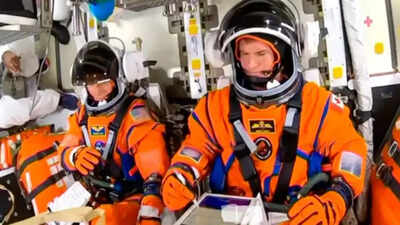
NASA astronauts aboard the Orion spacecraft spent the first hours after launch observing Earth and documenting views from space, even as the mission successfully executed a critical engine burn to propel itself toward the moon.Mission specialist Jeremy Hansen described the view from orbit, saying: “We got a beautiful view of the dark side of the Earth, which is lit by the Moon.” The crew was “glued to the windows” taking photographs, prioritizing the show over routine activities such as meals.Commander Reed Wiseman later called Ground Control to ask how to clean the spacecraft’s windows after continuous photography had left them dirty. Ground teams advised the crew to use water and wipe dry.
NASA confirmed that the images taken during the mission will be shared publicly once they are sent to Earth.
Artemis II completed the key burn, and the spacecraft exited Earth orbit
The mission marked a major milestone after Orion completed a lunar burn, a maneuver that propels the spacecraft from Earth’s orbit toward the Moon.The burn began at 19:49 EDT (23:49 GMT) and lasted just under six minutes. NASA described the operation as “flawless,” stressing that the crew and spacecraft systems were working as expected.
After the maneuver, Hansen said: “Humanity has shown once again what we are capable of,” in his first comments after the burn.The spacecraft began the burn process at its lowest orbital point relative to Earth, a planned trajectory designed for maximum efficiency and accuracy.
NASA says the crew and systems are working as planned
NASA officials said the Artemis 2 mission is progressing according to plan, with all major systems operating within expected parameters.In a press conference after the burn, Artemis science lead Lori Glaze said the spacecraft remained “on the trajectory we designed” and stressed that the astronauts were “doing great.”Flight data collected so far includes climb performance, manual flight testing during close operations, and verification of life support systems such as carbon dioxide scrubbers, all of which worked successfully.Ascension flight director Judd Freeling said the Space Launch System placed Orion precisely into its intended orbit, with subsequent burns carried out as planned.Howard Ho, Orion’s program manager, compared the mission phase to “test driving a car,” noting that the goals of manual control and system validation had been achieved.
The mission remains a test flight, and a lunar landing is not planned
NASA reiterated that Artemis II is a test mission aimed at evaluating how the Space Launch System rocket, Orion spacecraft and human crew work together in deep space conditions.The mission will not include landing on the moon. Instead, the Orion capsule will travel around the moon and return, allowing engineers to collect data important for future manned lunar landings.Officials said the coming days will focus on extracting as much data as possible from the flight, with an emphasis on system performance and crew operations.While minor issues are expected as part of the testing, NASA noted that the mission has so far achieved all key objectives, marking an important step in its broader lunar exploration program.