

Concrete has been the backbone of construction for centuries. Roads, bridges, skyscrapers, all based on the same old inert material. It is difficult, persistent and predictable.
But a new material is quietly challenging that standard. It grows, breathes and even heals its cracks. Scientists have created a living wall material that behaves more like a mini-ecosystem than a traditional building block. It sounds like science fiction, but it has already been used in large-scale installations. Unlike regular concrete, this material changes over time. It captures carbon, builds itself, and responds to its environment.
And while it may not replace concrete tomorrow, it points to a very different future for architecture.
Inside the Canada Pavilion: walls that live, breathe and require daily care
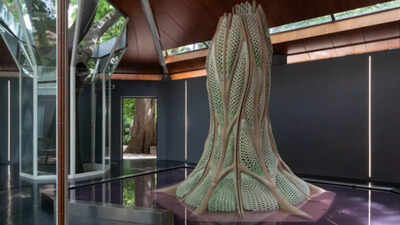
According to ArchDaily, at the 2025 Venice Architecture Biennale, visitors to the Canada Pavilion saw something unusual. The walls were smooth, textured, and almost organic. And these structures weren’t just displays: these structures, called picoplanktonics, were embedded with living cyanobacteria. This means that installation requires daily care.
The light, the temperature, the humidity, it all has to be just right. If the microbes fail, the structure itself will weaken.
The pavilion was more like a greenhouse than a building. It may seem strange to think of a wall that needs attention, but that’s exactly what makes the concept exciting. Architecture that lives. Architecture that breathes.So how does it actually work? Tiny cyanobacteria are housed inside a printable hydrogel.
They carry out photosynthesis, converting sunlight and carbon dioxide into biomass. Over time, they grow and multiply, slowly changing the materials around them. Within a month, the samples gained approximately 36% more mass than the inanimate control group. This increase is the result of two processes. The first is direct biological growth. The other is microbial-induced carbonate precipitation, or MICP.
Microbes create alkaline conditions that convert dissolved ions into solid minerals.
Over time, these minerals accumulate, strengthening the structure from within. The wall literally gets harder with age.
Carbon capture and the surprising role of form in living walls
This material does more than just self-repair. It captures carbon. According to the research published in Nature, titled “Dual Carbon Sequestration Using Photosynthetic Living Materials,” early tests showed that it absorbed about 2.2 milligrams of carbon dioxide per gram of hydrogel in the first month. It may not seem like much. But after more than a year, the total stored carbon reached roughly 26 milligrams per gram, most of it in stable mineral form.
It works slowly. Experts point out that industrial systems are faster, but also require energy and chemicals. This living wall works with sunlight and air. This simplicity could be valuable if it could be scaled up.
Buildings can passively help combat climate change while continuing to perform their natural functions.One surprising finding is that form affects performance. Flat blocks of hydrogel are not ideal. They block light, limit airflow, and reduce bacterial activity. So the researchers experimented with mesh structures, porous shapes, and even coral-inspired textures. Some designs increased volume while maintaining surface area. This allowed the cyanobacteria to remain active and healthy. The unusual appearance of the pavilion was not only aesthetic.
Every curve and every hole was functional. Living materials need space, light, and exchange to survive.