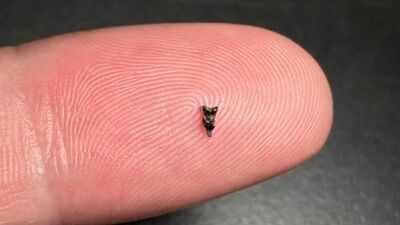
PC: Discover Magazine (Image source: Dr. Stephen Chester)
A small tooth can disappear between your fingertips without much effort. However, some of the earliest clues to our evolutionary story come from fossils no older than that. In collections of ancient mammal remains from western North America, paleontologists have spent decades piecing together parts of a creature called purgatorius.
These small, tree-dwelling mammals lived shortly after the dinosaurs became extinct. Their remains are often limited to isolated teeth and jaw fragments, but these fragments have become key to understanding these early primate relatives. Now, new fossil evidence from Colorado is helping fill a long-standing gap in that picture. This discovery extends the known range of Purgatorius farther south than previously documented during the early part of the Paleocene, and provides new insight into how some early primate relatives spread across ancient North America.
How Purgatorius fossil teeth reveal early primate origins
It is difficult to reconstruct the early stages of primate evolution because complete skeletons are rare. Most of what scientists know comes from teeth. They are well preserved, bear distinctive anatomical features, and often survive when the rest of the skeleton is long gone. That’s why the Purgatory fossils have attracted so much attention. The animal lived approximately 66 million years ago, during the period immediately following the asteroid impact, which ended the era of non-bird dinosaurs.
Although it was not a primate in the modern sense, it belonged to a group widely considered to be among the closest known relatives of the first primates. Its teeth indicate a small mammal that has adapted to life among the branches, and feeds on a diverse diet that may include fruits, seeds, and insects. For scientists searching for the roots of the primate family tree, these dental remains provide some of the oldest evidence available.
Ancient Purgatorius teeth found in Colorado reveal new evidence
For many years, the earliest known examples of purgatory came from the Far North, especially Montana and Saskatchewan. This pattern has led to questions about where these early primate relatives first appeared, and how quickly they expanded into other regions after the mass extinction event.According to a study published in the Journal of Vertebrate Paleontology, titled “Purgatorius Occurrence in the Far South Sheds Light on Biogeographic History and Diversity of Primate Relatives,” Purgatorius fossils were recovered from the Coral Bluffs area of the Denver Basin in Colorado.
These remains represent the first known appearance of a Puercan-era plesiadapiform species in southern Montana, helping to fill a geographic gap that has puzzled paleontologists for years.The fossils were recovered through extensive sediment washing, a method designed to capture remains so small that traditional collection methods can easily miss them. Some of the teeth display a combination of features not seen in previously described specimens and may belong to a distinct early type of antiseptic.
What Colorado fossil teeth Reveal the purifier
At first glance, a handful of isolated teeth may seem like limited evidence. However, fossil teeth contain an extraordinary amount of information.The shape of cusps, ridges, and chewing surfaces can reveal evolutionary relationships between species. Small differences may indicate whether populations are isolated, adapting to different environments, or branching off into separate lineages.According to the study, Colorado fossils suggest that Purgatorius may have originated in northern regions before spreading southward during the early Paleocene.
The discovery also raises the possibility that the apparent absence of these animals in southern parts of North America was not entirely real. Alternatively, it may reflect gaps in fossil specimens.In other words, the animals could have been there all along, but their remains were simply too small and too rare to be discovered until more intensive research methods were used.
Small in size Purgatorius fossils Highlighting post-dinosaur evolution
The timing of the discovery is particularly important. The fossils come from a world still recovering from the End-Cretaceous extinction, one of the most significant biological upheavals in Earth’s history.As ecosystems rebuilt themselves, mammals began to occupy ecological roles previously dominated by dinosaurs. Small tree-dwelling species appear to be among the first to benefit from these changing environments.According to the study, these small fossils help shed light on the period when mammalian diversity began to expand. While large-bodied mammals would not appear until much later, creatures like Purgatory were already experimenting with lifestyles and diets that foreshadowed the evolution of later primates.The story is not one of sudden transformation. It is a record assembled from parts, often measured in millimeters rather than metres.