

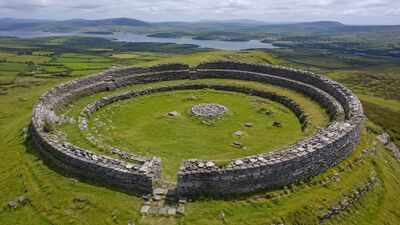
Long before written records describe the powerful kingdoms of Ireland, a large society had already taken shape in what is now County Armagh. Modern archaeological research suggests that this landscape was much more than a collection of scattered prehistoric ruins.
Instead, it appears to have been a carefully organized center where people lived, worked, traded and celebrated in one interconnected place around 1200 BC.The findings challenge the long-held view that large, planned settlements appeared later throughout Western Europe. Instead of Hoji Fort representing an isolated hilltop area, it now appears to have been part of a much larger landscape designed with distinct purposes in mind.
Evidence gathered through modern surveying and excavation methods indicates the presence of a settlement of surprising size, associated with artisanal production, ceremonial activity and long-distance exchange.
Together, these finds provide a different picture of Bronze Age Ireland, showing societies capable of organizing people, resources and space on a scale rarely associated with this period.
New evidence from one of Ireland’s oldest settlements
Haughey Castle has attracted archaeological interest for many years due to its location within the wider Navan complex in Northern Ireland.
Previous interpretations have largely focused on its Late Iron Age significance, but recent investigation has shifted attention several centuries further to the Late Bronze Age.The new study published in Cambridge University Press, titled “Hugi Fort: A Major Complex of Energy, Production and Ritual in Late Bronze Age Europe,” suggests that the fort contained more than 200 possible timber-built houses. Such a concentration of domestic buildings is unusual for prehistoric Ireland and indicates a settlement in which many families may have lived within a planned enclosure rather than occupying isolated farms spread across the countryside.Among these structures are several exceptionally large circular buildings up to 30 meters wide. Their size makes it unlikely that they served as ordinary homes. Instead, archaeologists believe that these buildings may have served as communal gathering places or institutional spaces where important social or political activities took place.
Hidden sacred landscape surrounding Hoji Castle
The research argues that Hogi Fort should no longer be viewed as a single stand-alone archaeological site.
Instead, they formed part of a broad landscape in which different areas played different roles but remained physically and symbolically connected.As reported by the University of Glasgow, one such site is King’s Stables, an artificially created swimming pool that appears to be intended for ritual practices. Excavations have uncovered evidence that casts of weapons, animal remains and human bone fragments were deliberately placed within the water, suggesting ceremonies linked to belief, memory or authority rather than everyday life.These sites were connected by a large wooden road surrounded by a massive wooden fence. This route may have guided organized processions between the settlement and the ceremonial area, reinforcing social traditions through carefully planned movement across the landscape.
Signs of specialized production and far-reaching trade
Life at Haughey Castle extended beyond farming. Archaeological evidence points to the manufacture of specialized metals, including the production of bronze and gold objects that required skilled craftsmen and access to valuable raw materials.Large communal feasts also appear to have formed part of life in the settlement. Such gatherings often played an important role in maintaining alliances, displaying wealth, and strengthening political relationships in prehistoric societies.Objects originating outside of Ireland indicate that the community maintained contacts with distant regions across Europe. Artifacts associated with regions including the Iberian Peninsula and Central Europe indicate that exchange networks extended over great distances, allowing ideas, materials, and prestigious goods to spread between communities hundreds or even thousands of kilometers apart.
One of the largest prehistoric landscapes in Ireland
Another important aspect of the study centers on nearby Creeveroe Earthworks. Rather than representing an isolated feature, archaeologists now interpret this enormous enclosed area as forming part of the same Bronze Age complex.Covering around 109 hectares, the area is among the largest known prehistoric monuments in Ireland or Britain. To illustrate its size, the enclosed area is roughly equivalent to about 155 football fields.