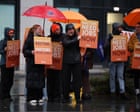
Resident doctors in England They voted to strike for another six months in their long-standing jobs and over a wage dispute with the government.
Their decision means that unless an agreement is reached, the strike campaign by the resident – formerly junior – doctors will enter its fourth year. Industrial action started in March 2023.
93% of resident doctors who voted in their latest strike ballot by the British Medical Association (BMA) approved the next round of stoppages. In all, 26,696 of the 28,598 resident doctors who took part supported the ongoing industrial action – 53% of the vote.
Branch health And social care (DHSC) highlighted that the turnout was the lowest ever seen in the five strike ballots held as part of the action. This is a third less than the 78% voter turnout in early 2023.
The ballot results showed that less than half of all resident doctor members of the BMA – 49% – voted for strike, down 0.7% on their previous ballot.
The medical association blamed the ministers for the ballot results. It says the government is doing little to address the shortage of training places for early-career doctors looking to specialize in their chosen field of medicine and is not giving them the 26% pay rise they are seeking.
“Ministers cannot be surprised that 93% of doctors voted to strike after this year’s pay cuts. The same health secretary promised fair pay for travel,” said Dr Jack Fletcher, Chairman of the BMA Resident Doctors Committee.
“And without thousands more training posts, the barriers to medical training are going to continue to rob them of their careers. Doctors This is clearly unacceptable today.
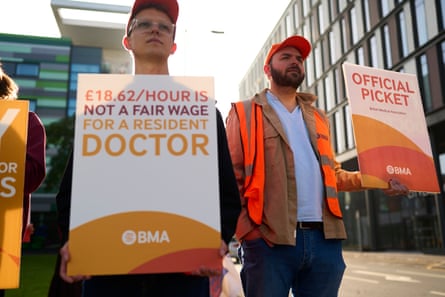
Wes Streeting, the health secretary, is promising to create 1,000 to 2,000 and then 4,000 training places to try to meet the BMA’s demand. He and the BMA held what the DHSC called “intense and constructive discussions” last month on two key issues, but they did not find a solution.
Fletcher says strikes can still be avoided. “None of this necessarily indicates more strikes. The government has shown a better tone in recent weeks compared to the name-calling we saw late last year,” he said.
“A deal has to be struck: a new jobs package and an offer of pay rises over several years can be worked out in good faith on both sides in the interests of patients, staff and the whole. NHS.”
He urged the health secretary to adopt a “responsible approach” in the search for a “timely solution without the need for further strikes”.
Both Streeting and Prime Minister Keir Starmer were heavily critical of resident doctors ahead of their final strike before Christmas. Their language has hardened doctors’ resolve to press ahead with their demands, BMA sources say.
Streeting called the BMA’s 26% pay claim unaffordable, despite being stretched over several years. The DHSC said resident doctors’ salaries had risen by 28.9% in the past three years, with 22% of that coming in the two-year contract following Labour’s 2024 election victory.
It has also suggested fast-track legislation to prioritize training places for graduates of UK medical schools, which was recently tabled in Parliament, as evidence of its determination to address that issue. But the promised numbers are not enough for the BMA.
Each of the five-day strikes by resident doctors has caused significant disruption to NHS services and is estimated to cost the service £250m.
Matthew Taylor, interim chief executive of the NHS Confederation and NHS Providers, said doctors “need to reflect on the impact of further industrial action on patients, the difficult economic environment we are operating in and the generous pay rises the government has already given them before carrying out further walkouts”.