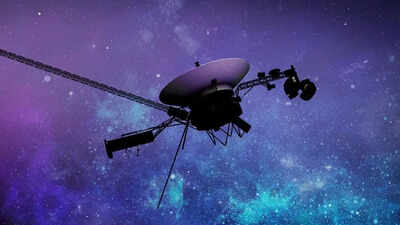
Launched nearly 49 years ago, NASA’s Voyager 1 spacecraft is still actively traveling through deep space, currently more than 15 billion miles from Earth. Voyager 1 was created by humans and is the furthest distance any human-made object has ever traveled.
However, Voyager 1 faces a power emergency due to its radioisotope thermoelectric generators losing approximately four watts of power each year. Without power, Voyager 1 would automatically enter error-protected mode and would not be operational to support future scientific observations. To avoid this situation, JPL engineers have begun the process of decommissioning non-essential systems in a way that will allow JPL to continue the ability to communicate with and receive scientific data from the outskirts of our solar system throughout the 2030s.
NASA’s new strategy keeps the 49-year-old Voyager 1 spacecraft alive despite losing power
As part of NASA’s ongoing efforts to support the Voyager 1 mission, the agency made another decision to deactivate a key science instrument: the Low Energy Charged Particle (LECP) experiment was intentionally shut down on April 17, 2026, as reported in NASA Science. LECP has provided nearly continuous measurements of ions, electrons and cosmic rays from outside the heliosphere since the spacecraft’s launch in 1977.
The decision to deactivate LECP was made according to a pre-defined hierarchy of priorities to continue keeping the most critical systems operational for as long as possible. Disabling the LECP will make it easier for engineers to optimize the spacecraft’s power output and avoid future failures of the spacecraft’s systems during its long journey through the interstellar medium.
NASA’s “Big Bang” Strategy for Voyager’s Survival
According to NASA, they are currently planning an ambitious plan called “Big Bang” to increase the operational life of the Voyager spacecraft.
The plan involves the coordinated reconfiguration of several on-board components through on-board component reconfiguration. The goal of this plan is to make the most of the remaining available energy while keeping the spacecraft warm enough to avoid freezing the fuel line. NASA plans to test this new procedure on Voyager 2 in May and June 2026, and if successful, will apply the same solution to Voyager 1 no later than July with very little possibility of reactivating previously locked instruments.
The reality of communicating with Voyager 1
Long-distance spacecraft must face distinct logistical challenges when operating an operationally autonomous spacecraft like Voyager 1, which is 23 light-hours from Earth; Therefore, each command issued by ground control takes approximately a full day before it reaches the probe, and then approximately a full day after the probe receives the command before it can confirm that the command has been received. This capability (or rather loss of capability) requires mission managers to manage in a manner much different from that which is typical of successful manned spacecraft by exercising a level of caution and deliberation, where real-time troubleshooting can never be accomplished.
Currently, Voyager 1 maintains contact with Earth via two terminal science instruments on board – the plasma wave subsystems and the magnetometer – allowing the continuous transmission of new and revolutionary scientific data originating from regions of space never before traveled by a human-designed spacecraft.