

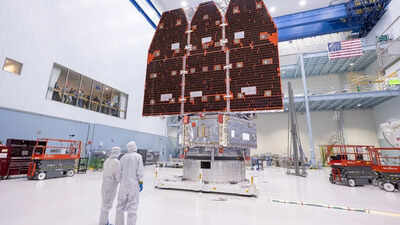
The Nancy Grace Roman Space Telescope has now reached a major turning point, with NASA confirming that its final assembly has been completed at Goddard Space Flight Center in Maryland. The observatory, often described as the next big step after Hubble and the James Webb Space Telescope, is now fully built and preparing for launches expected in 2026.
As reported, engineers recently finished integrating its main systems within a large clean room, marking the end of years of construction work. The mission is designed to survey large areas of the sky in visible and near-infrared light, producing data on a scale that has never been achieved before. NASA scientists say it could open new paths to understanding dark energy and the formation of galaxies and distant planetary systems.
NASA completes assembly of the Romanian space telescope before its launch in 2026
Inside NASA’s Goddard facility, the telescope is now fully assembled.
It is a large structure equipped with solar panels, optical systems and sensitive scientific instruments. The integration process combined the spacecraft and telescope modules within a carefully controlled cleanroom environment. With this phase completed, Roman moves from the construction phase to final testing and preparation for launch. Engineers working on the project described this phase as one of the most important milestones in the mission’s timeline.
Roman is not designed to replace existing space telescopes. It has a completely different purpose. Its primary mirror is about 2.4 meters wide, similar to Hubble’s. The difference comes in the amount of sky that can be observed at one time. Each image will cover an area of sky about 100 times larger than what Hubble can capture in a single shot. This alone changes the way astronomers study the universe. NASA reported that Roman can collect data about 1,000 times faster than Hubble when conducting surveys.
Watch the NASA press conference: Nancy Grace Roman space telescope completed
He watches
NASA press conference: The Nancy Grace Roman Space Telescope is complete
The Roman space telescope repeatedly scanned the sky for space events
One of the most important features of the Roman is his ability to observe large areas repeatedly. This approach allows scientists to detect surprising cosmic events that might otherwise be missed. By scanning the same areas regularly, the telescope increases the chances of capturing these short-lived phenomena. Researchers expect to discover thousands of supernovae during the mission.
What was the main goal of the Roman mission?
The main goal of the Romanian mission is to study dark energy and dark matter.
These two elements are still not directly understood. However, it seems to dominate most of the structure of the universe.Galaxies behave as if there is more mass than can be seen. At the same time, the expansion of the universe is accelerating. The Romans would not detect these phenomena directly. Instead, it will map how galaxies are distributed and how they move over time.By building large 3D maps of the universe, scientists hope to improve models of cosmic expansion.
How the Romanian space telescope will discover hidden exoplanets
Besides the wide-angle scanning camera, Roman carries a specialized instrument called a coronagraph. Their job is to block out bright starlight so that faint nearby objects can be seen. This may allow direct imaging of large exoplanets, especially gas giants similar to Jupiter.NASA reports that the system may discover planets up to 100 million times less luminous than their host stars. It’s a high-tech capability, still experimental in many ways, but important for future planet-hunting missions.
It does not focus on Earth-like planets yet, but it is helping to improve the methods needed to study them later.Roman is expected to be launched aboard a SpaceX Falcon Heavy rocket. After launch, it will travel approximately one million miles from Earth to a stable location known as Lagrange Point 2. This location provides a stable environment with minimal interference from the Earth or the Sun. Before launch, the telescope will undergo final testing, including vibration and thermal simulations that simulate the extreme conditions of space. These tests are designed to ensure that the system can survive launch and operate reliably once deployed. After that, it will be shipped to Kennedy Space Center for final preparations.