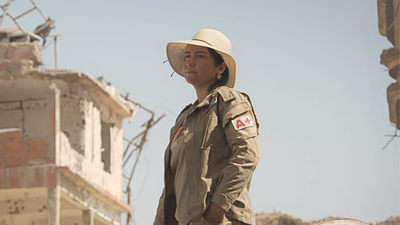
In northern Iraq, Hanaa Khader wanders among destroyed buildings and empty fields searching for hidden explosives left behind by ISIS. A Yazidi deminer leads a women’s team removing landmines and booby traps from villages destroyed during the war.
Every mission carries enormous risk, as even one mistake could lead to a deadly explosion. Khader’s work was recently featured in Into the Fire, a short documentary featuring the Nobel Prize and produced in collaboration with Grain Media. The film is part of a five-part series showing how efforts associated with the Nobel Peace Prize continue to impact people’s lives years later.
Hanaa Khader’s mission to remove landmines was born out of tragedy
Khader belongs to Iraq’s Yazidi minority, a sect that suffered devastating violence during the ISIS attack on Sinjar and its surrounding areas in 2014.
Thousands of Yazidis were killed, displaced or kidnapped when ISIS fighters seized villages in northern Iraq. Even after the armed group lost control of the territory, the danger did not disappear.Explosives hidden inside homes, schools, farmland and roads continued to threaten families trying to return. For many communities, rebuilding can only begin after the mines are cleared.Here Khader and her team intervened.
The documentary shows Khader and her colleagues carefully scanning the ground with metal detectors as they move through affected neighborhoods. The women inspect collapsed buildings, dusty corridors and empty fields where explosives may still be buried beneath the surface.Many of the devices are improvised booby traps deliberately planted by ISIS fighters. Other causes include landmines or hidden ammunition left behind during fighting.
The work requires a great deal of patience and precision, because one wrong move could be fatal.In the film, Khader talks about how life changed after ISIS entered the region. She remembers that she once tended a peaceful garden before the war turned her surroundings into a deadly landscape filled with explosives.
Why only the women’s team?
The demining team carries a symbolic significance that goes beyond the dangerous work itself. Many Yazidi women suffered severe trauma during the ISIS conflict, including forced displacement and violence.
By practicing one of the most dangerous professions in the world, these women are helping to reclaim control over a land once controlled by fear.Their work also directly impacts displaced families hoping to return home. Removing explosives allows children to play safely again, and farmers to work their lands and communities to slowly rebuild daily life.The documentary highlights these emotional risks by showing local children near newly cleared areas, underscoring how closely demining is linked to restoring a sense of normalcy.
Nobel Prize connection
Into the Fire links Khadr’s mission to the broader humanitarian legacy of the International Campaign to Ban Landmines, which won the Nobel Peace Prize in 1997 for its efforts to eliminate anti-personnel mines around the world.Rather than focusing solely on political agreements, the documentary series explores how the work associated with the Nobel Prize continues decades later through people on the ground risking their lives for others.
Khader’s story reflects the long-term consequences of war and the continuing risks that civilians face long after the fighting has ended.
Restoring hope in post-ISIS Iraq
For Khader, demining is more than just removing explosives. It’s about giving people the opportunity to return home without fear. Every device that is safely cleared represents another piece of land reclaimed from violence.The film depicts her as a de-miner working to rebuild communities torn apart by conflict. In places where ISIS once spread terror, Hana Khader and her team are helping restore safety, recovery and hope.