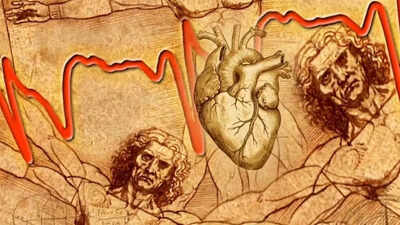
Leonardo da Vinci was drawing the human body long before the advent of modern medicine. One of his most curious drawings focused on the interior of the human heart, something most people at the time barely understood.
Reports indicate that the 500-year-old structure has puzzled scientists for a long time, but they now think they understand what da Vinci was looking at. It is a strange mesh-like structure inside the heart called trabeculae.For centuries, it has been in textbooks and scans, noticed but never really understood. Experts say it may play a role in the risk of heart disease. It may sound a bit dramatic, but the science behind it is surprisingly robust, tied to genetics, MRI scans, and large-scale data from thousands of people.
However, not everything is completely clear yet. Some pieces of the puzzle are missing.
Da Vinci’s heart drawings and the early discovery of trabeculae within the human heart
Da Vinci wasn’t just blindly guessing. He dissected human bodies himself, which was rare and somewhat controversial in his time. In his drawings of the heart, he noticed these branching, almost tree-like patterns within the rooms. He thought they might warm the blood. Like some kind of natural heating system. Creative idea. That’s not entirely true, experts say, but it’s not entirely out of spirit, either.
For hundreds of years, these structures did not receive much attention.
It was anatomically visible, sure, but mostly ignored as only internal tissue. According to the study published in Nature, titled “Genetic and Functional Insights into the Fractal Structure of the Heart,” these structures are called trabeculae. They form a kind of spongy, uneven lining inside the heart’s ventricles. More like tangled threads of muscle that appear to be more than just biological noise left over from evolution.
Researchers now think it may actually affect how blood flows and how efficiently the heart pumps. Some forms appear to be associated with better heart performance.
Wide-field MRI scans reveal trabecular patterns associated with heart disease risk
The scientists used MRI scans from large population studies, including data from tens of thousands of people. One of the largest sources was the UK Biobank. Certain trabecular patterns appear to be associated with an increased risk of cardiovascular disease. Nothing is absolute, nothing is final, but it is enough to raise eyebrows.
It wasn’t just a fantasy either. Computer simulations helped model blood flow through these structures.
The results suggested that the inner ‘texture’ of the heart may influence performance more than previously thought.
Genetics and fractal patterns explain how trabeculae form within the heart
Then came the genetic side of things. Researchers have reportedly identified multiple genetic loci linked to how these trabeculae form. So it’s not random. It has been encoded and integrated into biology since early evolution.
The structure itself follows so-called fractal patterns. This just means that they branch out in repetitive and similar ways. Such as trees, rivers, and even lightning. Experts say this type of architecture appears in nature when systems need efficiency in a limited space.
The heart seems to follow the same logic.
What Leonardo might have seen without knowing
There’s something a little strange about it. A Renaissance artist depicts a structure that genetics and modern photography can only now explain. Da Vinci didn’t have MRI machines or genomic maps, he only had observation. He may not have been right about the job, but he definitely saw something real. Not everything is solved. Some links between the shape of trabeculae and disease are still being tested. But the trend is clearer than it was a decade ago.