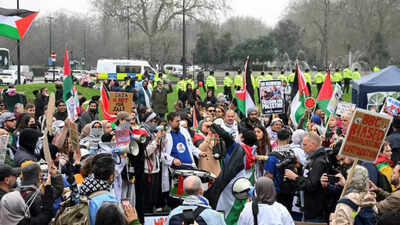
In an unprecedented move, the Metropolitan Police will use the River Thames to separate pro-Iran protesters from anti-Iran protesters in central London on Sunday, as the city braces for what police described as a “highly volatile” situation.Interior Minister Shabana Mahmood granted the Metropolitan Police’s request to ban the annual Quds Day march, organized by the Islamic Human Rights Commission (IHRC), citing rising tensions due to the ongoing conflict in Iran and the risk of serious public unrest. While the march is banned, the International Human Rights Committee plans to hold a fixed march on the south bank of the River Thames to press for the “liberation of Palestine.”
The Thames serves as a tactical gap
Assistant Commissioner Ade Adelekan said the Thames would act as a physical barrier between the two sides – a tactic the Metropolitan Police had never used before.
The Jerusalem rally will be limited to the Albert Embankment, while counter-protests, including groups opposed to the Iranian regime, pro-Israel, and exiled Iranian volunteers, will gather near Millbank. Lambeth Bridge will be closed to ensure separation, and marine police units will patrol the river.“This is a unique set of circumstances, and we need a unique tactical plan to keep people apart while allowing for lawful protest,” Adelkan said.
Heavy security presence
More than 1,000 officers from London and other forces are expected to patrol the area, with support on standby. Police expect the number of participants to reach around 12,000, although numbers may increase given recent events in the Middle East. Adelkan warned that although the measures are aimed at reducing risks, “there is no guarantee that disruption will not occur.”
Mobilizing counter-protests
Counter-protests include Stop the Hate, a Jewish group that campaigns against anti-Semitism at pro-Palestinian rallies, the Iranian Lion Guard, and the Free Iranian Alliance.
These groups plan to make their presence felt on the north bank of the Thames.Masoud Shadgarh, President of the International Commission on Human Rights, publicly expressed his support for Iran’s Supreme Leader Ayatollah Ali Khamenei, calling on participants to join the Jerusalem march. Police highlighted an “intelligence gap” because organizers did not provide a full list of speakers or attendees, complicating risk assessments.
Zero tolerance for hate crimes
Adelkan stressed that while freedom of expression is respected, there is “zero tolerance for hate crimes,” and any participant who crosses the line will face arrest.The Metropolitan Police said the size and sophistication of the police deployed at Sunday’s events demonstrated the “unique” nature of the current situation and the first-of-its-kind approach to preventing clashes amid global tensions spilling over into the streets of London.