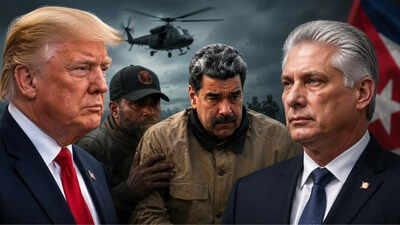
The United States under President Donald Trump is ramping up pressure on Cuba in ways that analysts say increasingly resemble Washington’s approach toward Venezuela before January’s dramatic operation that ousted Venezuelan President Nicolas Maduro from power.
However, despite comparisons between Caracas and Havana, experts believe Cuba represents a more complex, dangerous and potentially costly challenge for Washington.Controversy over possible US intervention escalated sharply after the Trump administration charged former Cuban President Raul Castro with shooting down two Rescue Brothers planes in 1996. The indictment was unveiled at the Freedom Tower in Miami, a symbolic site closely associated with Cuban exiles in the United States.
Critics of the move say the timing and location underscore its political importance, especially among Cuban American hardliners in Florida, a key political constituency for Trump and Secretary of State Marco Rubio.The accusations against Castro came amid a broader escalation campaign against Havana. Since January, the Trump administration has tightened sanctions, restricting shipments of Venezuelan oil to Cuba, threatening to impose tariffs on countries that supply the island with fuel, and imposing secondary sanctions targeting foreign companies doing business with Havana.
According to analysts William M. Leo Grande and Peter Kornblau, the strategy aims to pressure Cuba economically and force it to make political concessions or regime change.
Why are comparisons with Venezuela increasing?
The comparison with Venezuela stems from the operation carried out by Washington in January against Maduro. Maduro was indicted in New York on drug smuggling charges before US special forces carried out what officials described as a “sneak raid” that removed him from power.
His deputy, Delcy Rodriguez, then took control of the government.Now, with Castro indicted on conspiracy and murder charges, many observers see an implicit threat that Washington might attempt a similar operation in Cuba. The Trump administration has also amplified its rhetoric portraying Cuba as a national security threat. Officials accused Havana of hosting intelligence operations linked to Russia and China and conducting intelligence signals collection against the United States.
CIA Director John Ratcliffe reportedly warned Cuban officials during a rare visit to Havana in May that “time is running out” for Cuba to respond to Washington’s demands.US officials also claimed that Cuba had acquired hundreds of military drones capable of threatening US assets such as Guantanamo Bay and even Key West, Florida. However, many analysts and commentators have dismissed these claims as exaggerated.
Journalist Megyn Kelly said the idea that Cuba would launch an attack on the United States is “a bunch of nonsense” and said Havana “is in no position to threaten anyone.
“Cuba has strongly denied any intention to attack the United States while insisting that it has the right to defend itself. Cuban Deputy Foreign Minister Carlos Fernandez de Cosio said: “Like any country, Cuba has the right to defend itself against any external aggression.”
Why is Cuba different from Venezuela?
Despite the similarities in US pressure tactics, analysts believe that Cuba is structurally quite different from Venezuela and therefore difficult to destabilize quickly. Reuters reported that Venezuela has a defined succession structure and a prominent opposition movement led by Maria Corina Machado, who emerged as a key anti-Maduro figure after the disputed 2024 elections. Cuba lacks a similar opposition leader who enjoys mass support at the national level.Experts say Cuba’s state security apparatus has spent decades systematically eliminating alternative centers of power. Orlando Perez, a researcher on US-Latin American relations at the University of North Texas, noted that Cuban authorities “systematically dismantled every alternative or potential source of alternative energy.”The Cuban military is also considered more ideologically coherent and deeply rooted in the political system than the Venezuelan armed forces.
Analysts say Cuban security forces are more likely to resist foreign intervention and less vulnerable to internal division. Moreover, Cuban intelligence services have long experience working with Russia and China, giving them advanced surveillance and counterintelligence capabilities.Another critical difference is the leadership structure. While Maduro is the current president actively running Venezuela, Raul Castro is 94 and retired from formal leadership nearly a decade ago.
Although he retains influence, he no longer controls day-to-day management. Analysts say that even if Washington were to capture Castro, it would not necessarily destabilize Cuba’s political system in the way that Maduro’s overthrow derailed Venezuela.
Increased military signals
However, recent US military activity has raised speculation about possible intervention plans. According to reports, the US military has increased its intelligence-gathering flights near Cuba, while the aircraft carrier USS Nimitz entered the Caribbean on May 20, which also coincides with Cuban Independence Day.
US Southern Command also released promotional footage showing military aircraft, amphibious assault vehicles and troops along with images of Cuba.These developments have reinforced fears within Cuba that Washington may be preparing for military emergencies. However, analysts warn that the military signals do not necessarily indicate imminent invasion plans.Leogrande and Kornblau argue that a limited operation targeting Castro could theoretically succeed because of overwhelming US military superiority.
But they also warn that such a process would likely lead only to symbolic gains rather than real political transformation.They also point out that air strikes alone rarely lead to regime change. Pointing to ongoing conflicts involving Iran, the authors argue that bombing campaigns and targeted assassinations may weaken military leadership but do not necessarily lead to the collapse of governments.
The dangers of invasion and occupation
A large-scale invasion would pose greater risks. Analysts compare this scenario to the US invasion of Panama in 1989, which overthrew Manuel Noriega.
However, occupying Cuba would place enormous humanitarian and political burdens on Washington.The Cuban economy is already suffering from severe shortages of food, fuel, medicine and electricity. Experts warn that war or instability could lead to a widespread migration crisis, as thousands try to flee toward the United States.The island’s population exceeds 10 million, and analysts say the United States could become responsible for stabilizing and managing the severely faltering economy in the wake of the intervention.Another major concern is the lack of clear economic incentives. Venezuela has vast oil reserves that attracted international commercial interest after Maduro’s ouster. Cuba lacks a similar wealth of natural resources. The tourism industry has suffered for many years and has been further weakened by sanctions and economic decline.
Rubio’s central role
Secretary of State Marco Rubio has emerged as one of the strongest advocates of hardline policies against Havana.
A Florida politician and the son of Cuban immigrants, Rubio has long supported regime change in Cuba. Analysts say the dramatic political shift in Havana could significantly boost his future presidential ambitions.At the same time, failure may be politically damaging. The United States is already heavily engaged in military operations elsewhere, including Iran, while facing increasing financial pressures and budget deficits.
Critics warn that opening another geopolitical front in Cuba could drain U.S. resources and create unpredictable regional consequences.Rubio also intensified his direct messages to the Cuban public. And in M A Spanish-language video released on May 20 blamed Cuba’s economic difficulties on its leadership and denied that US sanctions were responsible. Rubio repeated Washington’s offer of humanitarian aid through the Catholic Church, declaring: “The only thing standing in the way of a better future is those who control your country.”
“
Legal and diplomatic complications
Legal hurdles may also complicate any broader US strategy. The Helms-Burton Act of 1996 severely restricts Washington’s ability to normalize relations with Cuba unless Havana undertakes major political reforms and democratization measures. Reuters noted that unlike Venezuela, where the United States changed its relations after the overthrow of Maduro without immediate institutional transformation, Cuba’s legal framework makes this flexibility more difficult.In addition, the Cuban economy remains dominated by the military-linked GAESA conglomerate, which controls key sectors including hotels, ports, banks and retail companies. These entities are already subject to US sanctions, further complicating the prospects for economic transformation.Despite rising tensions, Cuban officials continue to indicate their openness to negotiations. Recently, Cuba’s ambassador to the United Nations, Ernesto Soberon Guzman, said: “Cuba is ready to talk about everything with the United States.
“No topic is off limits in our conversations – based on reciprocity and equality.”However, Rubio appeared skeptical about diplomacy, saying the likelihood of a negotiated settlement was “not high.”
Is intervention imminent?
At present, there is no conclusive evidence that the United States is preparing for an immediate invasion of Cuba. However, the combination of legal action, economic pressure, military signaling, and increasingly confrontational rhetoric has intensified fears that Washington is abandoning diplomacy in favor of coercive regime change tactics.The Trump administration seems convinced that maximum pressure could bring about a political shift in Havana. However, experts repeatedly warn that Cuba is not Venezuela. Its political structure has become more cohesive, its security services more disciplined, and its society less divided around opposition movements.As tensions continue to rise, the main question is no longer whether Washington wants major political change in Cuba. Even deeper is whether the United States fully understands the enormous political, military, and humanitarian costs that such intervention could unleash across the Caribbean and the Americas more broadly.