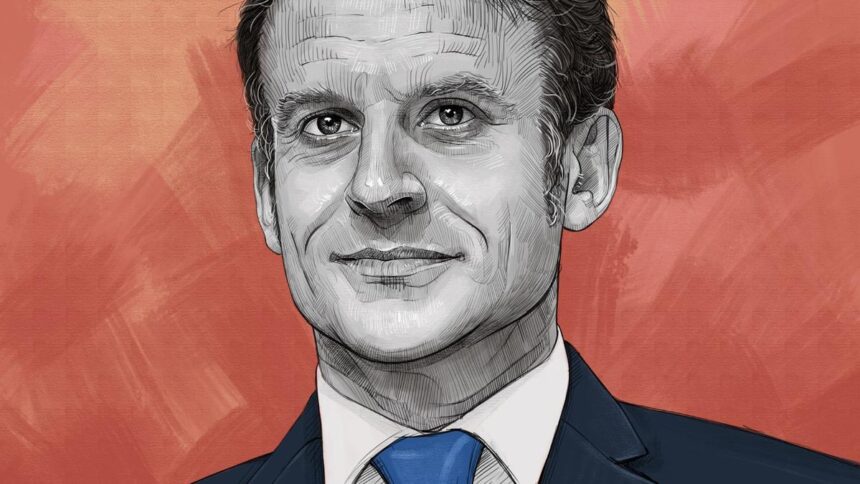
In 1962, French President Charles de Gaulle declared that “Europe must be organized without dependence on anyone”. As the world order now reevaluates itself in the light of various upheavals, the same rhetoric holds true in the same quarter 60 years ago. On February 13, at the Munich Security Conference, French President Emmanuel Macron said “Europe must learn to become a geopolitical power”.
Over the past few weeks, Mr Macron has made it clear that Europe must forge a path of ‘strategic autonomy’ by deepening the EU’s single market, reducing dependence on external powers, particularly in key areas such as AI and rare-earth minerals. (France is currently the only nuclear power in the EU). On January 20, at the World Economic Forum in Davos, the French President emphasized that “…building more economic sovereignty and a strategic economy, especially for Europeans…is the main answer”.

Mr. for European Autonomy. Macron’s push is the result of three major geopolitical realities facing Europe right now. One is the Russia-Ukraine war. Europe is providing arms and aid to Ukraine. Even with such help, Russia is steadily advancing into Ukrainian territory, with peace talks dragging on endlessly without progress. Economic sanctions against Russia as well as Europe’s support for Ukraine mean that Russia is no longer a reliable energy partner for the bloc.
Second, the dominance of China and Chinese companies in critical security sectors such as rare-earth minerals/metals. European investment could not cope with China’s position as a fierce competitor in these sectors.
Finally, and most alarming of all, is the instability of the US as a trade and security partner. Considered its most traditional trading partner and its biggest security guarantor under the NATO framework, the US has now become a flashpoint for Europe. If the heavy tariffs imposed by US President Donald Trump were not enough, his aggressive bid for ownership of Greenland under Danish sovereignty, Mr. suggested to Macron. “There were threats and threats and suddenly Washington backed down. And we think it’s over. But don’t believe it for a second,” Mr. Macron said in an interview earlier this month.
This is not the first time a French leader has presented his idea of European autonomy. Indeed, at the very beginning of his political career in 2017, his foreign policy prioritized strategic autonomy for Europe. Although the idea had few people then, Mr. Macron stuck to his initial stance. After a meeting with Chinese President Xi Jinping in 2023, he reiterated his position that Europe should not be “followers of America” and that it should not “get caught up in crises that are not ours”.
Now, by using the ‘Greenland Moment’, Mr. Macron has actively mobilized European powers. “On the trade front we have a Chinese tsunami, and we have minute-by-minute volatility on the American side,” Mr. Macron warned.

Regional mistrust
Mr Macron has called for European autonomy on two main policy pillars, the first being Eurobonds. As individual nation states may not be able to fund the scaling up of critical sectors, a common lending mechanism allows joint investments in specific industries such as security and defence, climate, AI and quantum computing. These “Eurobonds”, mr. Macron believes it can fund strategic investments for Europe and challenge the dominance of the US dollar.
The second policy is the Industrial Accelerator Act, which is expected to be published by the European Commission on February 25. The Act is intended to reconcile high-emitting industries with decarbonisation while maintaining competitiveness both domestically and internationally. One of its key provisions is the introduction of local-content ‘Made in Europe’ requirements in public procurement and consumer schemes. It also imposes some restrictive standards on foreign investment in the EU.
However, Mr. Macron is having a hard time convincing other European countries, especially Germany and Italy, Europe’s two main industrial powerhouses. His ‘Make in Europe’ rhetoric and pushback on foreign investment in critical sectors appeared too protectionist to Italian Prime Minister Giorgia Meloni and German Chancellor Friedrich Merz.
At an informal summit of EU leaders in Belgium on February 12, member states committed to the idea of ’one Europe, one market’, with Germany and France focusing on the goal of creating a “competitive industry in Europe”. whatever However, Mr. Macron always said “all this must be done in consultation and coordination with all European partners” and structured at the EU level.
Home insecurities
However, all such grand plans may come to naught if the extremist National Rally (RN) party comes to power in France’s presidential elections next year. Mr Macron cannot run because of the constitutional limit of two terms for the presidency. That means Emmanuel Macron has only one more year left in office. And if the RN comes to power, it will be Mr. There is no guarantee that Macron’s agenda and commitments to the EU will be respected, as the RN has always been a Eurosceptic party to the point of suggesting leaving the bloc at one point.
Mr. Macron is trying to expand his influence in the French bureaucracy and effectively stop Rally’s populist agenda by appointing close allies to top government posts, including replacing France’s top auditor and reorganizing foreign embassies.
Since his centrist coalition lost its majority in the European Parliament in 2024, Mr. Macron’s regime is unstable. Snap elections again resulted in a hung parliament, who installed three different prime ministers in a row until October 2025, each of whom was voted out by no-confidence motions or resigned due to political backlash.
A succession of short-lived governments has eroded Mr Macron’s status domestically and internationally. It remains to be seen how he tries to bridge his European agenda with the RN’s hypernationalist discourse.