How does one get star dust? As the Perry Como song suggests, one option is to catch a falling star and put it in your pocket, saying: Thousands of tons Cosmic dust bombards Earth every year, mostly evaporating in the atmosphere.
Fragments of asteroids and comets that don’t burn up – they’re called meteorites and micrometeorites when they hit Earth. provide scientists With valuable clues about the cosmos. That’s why the UK’s planetary scientists got into it Vacuum backpacks like Ghostbusterssearch cathedral roofs for microscopic specs of space stuff.
Another option is to recreate a bit of the universe in a bottle.
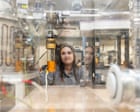
Linda Losurdo, a PhD candidate in materials and plasma physics at the University of Sydney, did exactly that, producing cosmic dust from scratch in the lab. It’s a feat she hopes will help shed new light on how life began on Earth.
Cosmic dust is thought to originate from dying stars. A star at the end of its life is “very hot and massive around the outer part,” Losurdo said. Falling apart under its own pressure, it “start[s] Loud carbon waves”.
“What can be seen around the envelopes of massive, dying stars [is] similar to what is seen in meteorites,” Losurdo said.
Cosmic dust contains organic compounds of carbon, hydrogen, oxygen, and nitrogen — collectively known as CHON molecules — that form the chemical building blocks of life.
Scientists are still debating whether the first locally formed CHON molecules on Earth came as particles from comets and asteroids, or were distributed during the early stages of our solar system’s formation, or a combination of the three.
Sign up for: AU Breaking News Email
Losurdo said recreating cosmic dust in the lab could help answer questions about how meteorites that hit Earth got the organic material they did. “We’re really interested in how we can better predict where the types of dust we find in meteorite samples come from.”
Cosmic dust emits a distinctive infrared fingerprint, a unique light pattern that reveals its chemical structure.
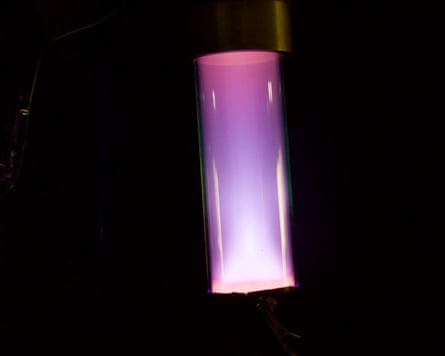
In the lab, Losurdo used such models to reverse-engineer dust, first using a vacuum to recreate the conditions of a vacuum in a glass tube.
To the tube, she and her supervisor, Professor David McKenzie of the University of Sydney, introduced a mixture of nitrogen, carbon dioxide and acetylene gases – “the kinds of gases you find around massive dying stars”.
“Then we’re able to apply a very high voltage — about 10,000 volts — and … it energizes the gas,” Losurdo said — creating a type of plasma, the fourth state of matter. “That’s our dust analog.”
Dr Sarah Webb, an astrophysicist at Swinburne University who was not involved in the research, said: “All these types of dust particles are the building blocks of our life on Earth. We wouldn’t be here without them.”
“We know they’re out there in the universe, all scattered here and there, but we can’t go clear and grab a bit of dust from the interstellar medium, even though we’d love to.”
Webb described Losurdo’s work as a “really beautiful method” for producing what we think interstellar dust looks like.
“One very exciting possibility, which is probably on track … is to use this type of simulated cosmic dust in other organic chemistry experiments, to simulate the formation of early life on different types of planets,” Webb said.
“What we’re doing is not representative of every single environment in the universe,” Losurdo emphasized.
“What we want to do is take a snapshot of what’s physically plausible and see if what we do compares to the real thing.”
The research was published in the Astrophysical Journal of the American Astronomical Society.