

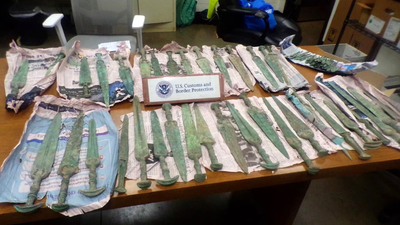
US authorities have seized a cache of ancient weapons after intercepting a shipment of 36 Bronze Age short swords and 50 arrowheads in the Port of Philadelphia. Archaeologists have confirmed that these artifacts, dating back nearly 4,000 years, are true cultural heritage items whose origins date back to ancient Iran.
US Customs and Border Protection carried out the seizure on February 18, 2026, after the shipment was flagged during a routine inspection. Officials said the weapons were misdeclared, routed through several countries, and were likely intended for the illicit antiquities market in the United States.
How were 4,000-year-old swords discovered?
The shipment was intercepted at the Port of Philadelphia after customs officials discovered irregularities in its papers.
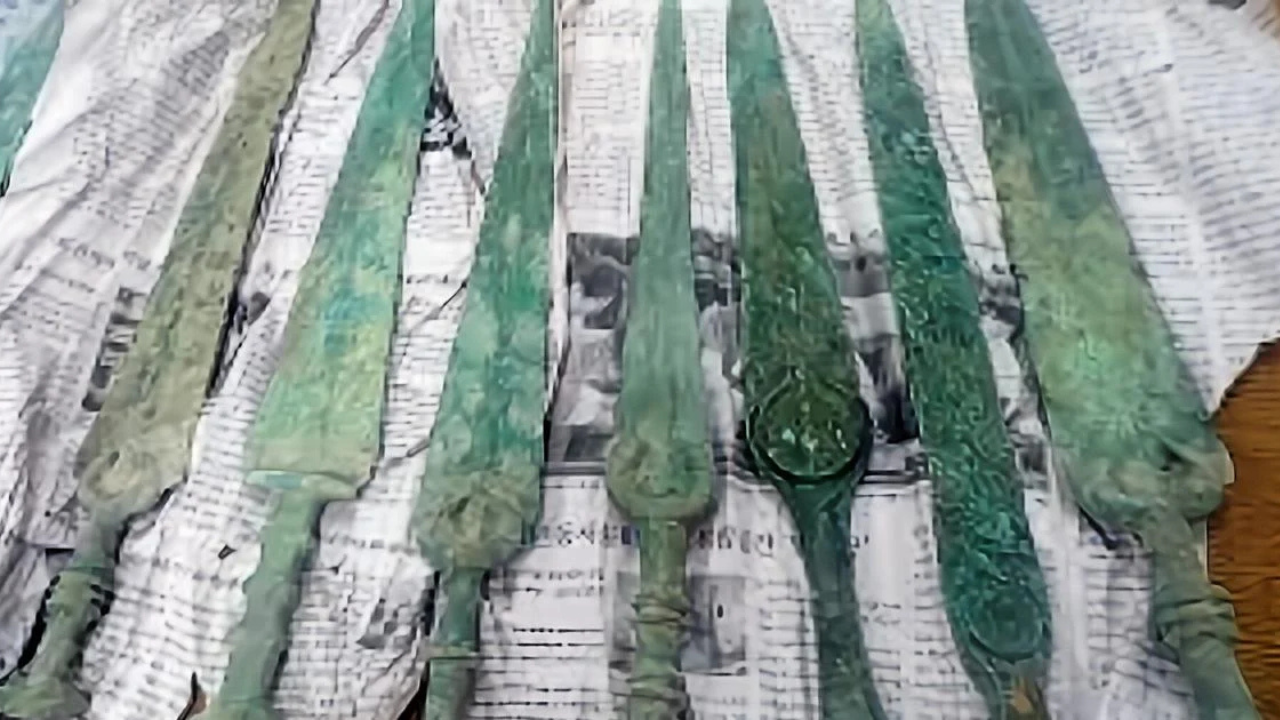
The shipment was declared as “metallic ornaments,” a description commonly used in antiquities smuggling to avoid closer inspection. Due to these discrepancies, the shipment was held for further review rather than released into circulation.An archaeologist examined the items on February 13, 2026, and confirmed that the swords and arrowheads date back to the Bronze Age, approximately between 1600 and 1000 BC. The weapons have been identified as authentic based on their metallurgy, shape, and wear patterns.
Experts said that these items match known examples of ancient Iranian weapons, which are cultural property protected under international agreements.Investigators said the weapons followed a multi-country route designed to conceal their origin. The shipment reportedly passed through South Korea and the United Arab Emirates before arriving in the United States. The artifacts were found wrapped in newspaper, a method often used by smugglers to conceal antiquities while limiting damage during transportation.
Authorities believe the shipment was destined for a private buyer in Florida, although no arrests have been announced.
Who made these weapons and who used them?
Archaeologists say Bronze Age metalworkers likely produced the swords and arrowheads found in ancient Iranian regions, especially areas near the Caspian Sea and the Talysh Mountains. During this period, craftsmen were highly skilled at alloying copper with tin to make bronze, a material strong enough to make weapons but rare enough to give them status.Short swords were typically used by local warriors, chieftains, or early military elites, rather than large standing armies. Designed for close combat, it was suitable for thrusting and cutting. Arrowheads could be used in both warfare and hunting, with bows remaining the most common long-range weapons of the era.
Why were Bronze Age swords important?
In Bronze Age societies, weapons were not simply tools of violence. Swords, in particular, were symbols of power and social rank, as their production required access to mineral resources, skilled labor, and trade networks.
Many of these weapons were buried with their owners or were deposited in ritual contexts, indicating that they held cultural and symbolic value beyond their practical use.The presence of swords and arrowheads in the seized consignment suggests that they may have been taken from burial sites or ancient settlements, rather than recovered from a single location. Looting these sites destroys the archaeological context, preventing historians from understanding how ancient societies organized war, leadership, and trade.
What weapons reveal about ancient Iran
During the Bronze Age, Iran was located at the crossroads of major trade routes linking Mesopotamia, Central Asia, and the Indus Valley. Such weapons reflect a time when societies became more hierarchical and conflict played an increasing role in political power. Differences in blade shape and metal composition help archaeologists trace regional patterns and technological exchange across the ancient world.Experts say that if the seized weapons are properly studied, they could provide valuable information about early metallurgy, war practices, and social organization in ancient Iran.
Once they are removed from their original context and sold on the black market, much of that information is permanently lost.The authorities stressed that no violent incident or security incident occurred at the port. The seizure resulted from routine customs enforcement procedures and expert documentation. Online jokes and viral posts referring to “ancient fighting” in Philadelphia were purely humorous reactions to the unusual nature of the discovery.