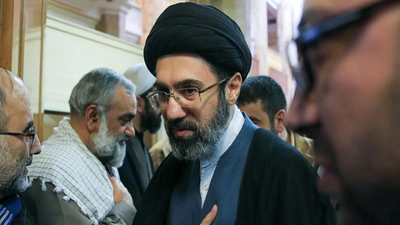
 According to a New York Times report, Khamenei underwent surgery on his hand, suffered severe facial burns and is awaiting an artificial leg after being injured in the strike.While he remains mentally capable of making decisions, his physical condition has greatly limited his direct participation.
limited control, Iranian Revolutionary Guard Influence grows
Four officials familiar with the matter, quoted by the New York Times, said that Khamenei had little contact with the Iranian generals during the ongoing negotiations.
Analysts point out that this has created a power vacuum that the Islamic Revolutionary Guard Corps is increasingly filling.“Mujtaba does not yet have full command or control,” Sanam Vakil, of Chatham House, told the New York Times, adding that decisions are often presented to him as a “fait accompli.”Ali Fayez of the International Crisis Group echoed this view, saying: “Mojtaba is not the supreme leader; he may be a commander in name, but he is not the supreme leader as his father was… Mojtaba is affiliated with the Revolutionary Guard,” as reported by the New York Times.
Governance changes amid the pressures of war
According to the New York Times, the Iranian Revolutionary Guard played a decisive role in halting planned talks with the United States in Islamabad, bypassing Iran’s civilian leadership, including President Masoud Pezeshkian and Foreign Minister Abbas Araqchi.Khamenei, who succeeded his father Ali Khamenei after his death in US-Israeli raids, has not made any public appearances or made verbal statements since taking office, to avoid appearing weak.Read also“Don’t rush me”: Trump denies setting a deadline for Iran’s proposal; He rejects nuclear optionsInstead, he is communicated through hand-delivered sealed letters.
The emergence of “board-style” leadership.
Describing the evolving power structure, former advisor Abdul Reza Davari told the New York Times: “Mojtaba runs the country as if he were the director of the board… The generals are the members of the board.”This shift represents a departure from the previous central authority under his father, with military commanders now playing a more dominant role in the decision-making process.These developments come with the continuation of an indefinite ceasefire between Iran and the United States, as the two sides evaluate paths for resuming negotiations and reopening the Strait of Hormuz.However, as internal power dynamics change and the IRGC asserts greater control, the prospects for diplomacy remain uncertain.