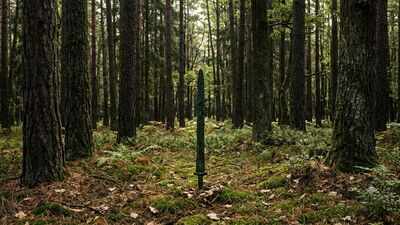
Ancient swords are uncovered from time to time across Europe, but a few discoveries immediately raise questions about how they got to where they were found. A bronze sword recently discovered in northern Poland is one of those rare cases.
Dating back about 2,700 years, the weapon was discovered upright on the ground, an unusual position that has led archaeologists to consider whether it was placed deliberately as part of a ritual or was accidentally lost.In addition to its stunning appearance, the well-preserved blade provides valuable clues about Bronze Age craftsmanship, wealth and beliefs. It also adds another chapter to the long archaeological history of the forests surrounding Gdańsk, where remarkable finds have previously emerged.
Polish forest where a 2,700-year-old sword stands upright
The sword was discovered during a legal metal detector survey in forests run by the Gdańsk Forest District in northern Poland. The detectorist, Marcin Visniewski, realized that the object might have archaeological significance almost immediately.Instead of digging it out of the ground, he left it where it was, marked the site and contacted heritage officials and local forest authorities.
This decision means that professionals can inspect the surrounding area before anything is disturbed, preserving details that are often lost when objects are removed without documentation.Once the archaeologists arrived, they conducted a controlled excavation and recorded the blade exactly as it was found. Although the surrounding soil did not yield any additional artifacts, the unusual location of the sword remains one of the most interesting aspects of the discovery.Accidentally lost objects rarely remain upright after centuries underground. For this reason, archaeologists believe the weapon may have been placed intentionally rather than dropped by accident. It is impossible to determine with certainty whether this act was part of a ritual, symbolic display, or other practice, but intentional deposit is considered the most likely explanation.
what Bronze Age sword He reveals his age and industry
Initial examination places the sword between about 900 and 700 BC, during the last centuries of the European Bronze Age.
It is about 60 cm long and belongs to a tang-handled design, which means that the handle was originally attached to a narrow metal extension.The fist itself has not survived. Materials such as wood, bone, or antler will gradually decay over thousands of years, leaving behind only the bronze blade. However, the weapon is still in unusually good condition.A green patina has formed naturally on the surface, protecting much of the metal underneath.
Decorative grooves, incised curvilinear decorations, and short intersecting lines are still visible, providing clues that may help specialists identify the workshop or the cultural traditions from which it arose. Conservation work is expected to further improve its classification.
What made Bronze Age swords so valuable?
During the Bronze Age, such weapons represented much more than practical tools. Producing a bronze sword requires access to valuable raw materials, skilled metalworkers, and a significant amount of time, making ownership beyond the reach of most people.State forests in Poland suggested that a sword of this quality would have represented wealth comparable to an entire herd of cattle. Such objects likely carry social significance alongside their practical function, serving as symbols of status, authority or prestige within local communities.This value also makes the possibility of making a deliberate offer more interesting. Depositing such an expensive possession would have required meaningful decision making rather than casual action.
The forgotten archaeological legacy of the forest
The latest discovery is not the first indication that the surrounding forest was important in ancient times. Nearly a century ago, two air-hilted bronze swords were recovered from a nearby swamp within the same forest area.Those earlier finds were transferred to the Regional Museum in Gdańsk but disappeared during the turmoil of World War II. Its loss means that the newly discovered weapon has become a particularly important addition to the archaeological record of the region.Although decades apart, both finds indicate that this landscape may have been used repeatedly during the Bronze Age in activities that extended far beyond settlement or ordinary travel.