

nNightclubs, mechanics, restaurants, a theatre, a wholesale butcher and an apostolic church occupy some of the network of caves and tunnels dug over the centuries at Monte Testaccio, an ancient landfill mound in central Rome made entirely of broken amphorae. Some places make a feature of their setting, revealing parts of the vessels not unlike the cross-section of a cut wafer, while others have smoothed the curves with plaster.
A few of them use caves as they were originally intended, i.e. as natural reservoirs that provide constant low temperatures and good humidity. In short: the ideal temperature for storing certain foods and wines. Recently, Vincenzo Mancini, whose DOL project distributes artisanal products from a small agricultural estate in Lazio, took over a deep cave behind Door 93, reclaiming it as an ancient urban space for cheese and cured meats. A few months ago I visited with Trullo Chefs in London, to taste cheese – and to have an unexpected meal. Cheese and black pepper.
Cheese and cheese: Two words for cheese. The older of the two is casio, from the Latin word cassio cheesewhich may come from cohaesus (Consolidated) describes the transformation of milk into curds. Formaggio later came from medieval Latin appearance (Shape), which in turn comes from the Greek word φόρμος, which is the name given to the wicker bowl in which the curdled milk is placed in order to strain and shape it.
The agronomist Columella wrote around 50 AD: “The best cheeses are those made with the least possible amount of medicines!” No change there then. His treatise on agriculture, De Re Rustica, also includes detailed instructions on cheesemaking, in particular how to heat fresh sheep’s milk with mutton or a little rennet until it coagulates into curds and watery whey. The curds were filtered into baskets, sprinkled with salt, and then left in a cool, dark place. At the time, cheese was also a daily result of many herds traveling with hordes – which brings us to what food writer Eleonora Baldwin described as Energy bar (energy bar) that walking men receive daily. This means a piece of cheese.
The name Pecorino in relation to cheese came later from Latin cattle cattle (sheep). Like Cassio, Pecorino was (and still is) a general term applied to infinite forms, which historically did not need any qualification or geographical identity because they He was Local cheese (Cacio). Only when products travel beyond where they are manufactured should they be identified, protected and marketed, which is why we… Pecorino Sardinia, Pecorino Romano, Pecorino Siciliano, Pecorino Toscano, Pecorino Villano, Pecorino Crotone …And these are just the people with official status – there are hundreds more.
While the pecorino Romano is not the only pecorino in the food story of Rome and Lazio, it has been around since ancient times Casio. (It’s also important to note that following laws put in place in the late 19th century and the effects of urban growth in the 1950s, more than 95% of Pecorino Romano was produced on the cheese-making island of Sardinia, with the rest in Lazio and the Tuscan province of Grosseto.) Focusing on Lazio, Vincenzo works with the DiRoma dairy in Torretta Tiberina, where he takes wheels of Pecorino for 12 months. Romano, its peels are still a pale straw color, which leads to aging. It’s not just the cave’s microclimate; The microscopic bacterial flora within the walls play a role in flavor development, with the creamy, coarse and sharp (salty) flavor deepening and becoming more stubborn at 24, 36, 48 months and beyond. Rounds also develop carefully controlled coats of mold, ranging from mottled brown to dark moss green.
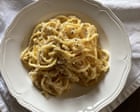
The next cave is occupied by a restaurant called Flavio al villafodito, so when the conversation turned to how best to turn pecorino romano (cacio) and black pepper (pepe) into the creamy sauce so trendy today, Vincenzo moved from cave to cave. He came back with a cloth full of just cooked food Tonsearsinto which he threw a handful of pecorino and grated black pepper for 36 months, then collected it, shook it, rubbed it, and served it. The performance was interesting because this is likely how patrons, with their cheese-making equipment and daily supplies, prepared the dish – and also how clever innkeepers got customers to drink more. It was even more interesting because the fine, sandy cheese particles stuck to the fresh pasta like sand. And it’s worth a try: estimate 150g fresh pasta, 50g grated pecorino and a heaping teaspoon of freshly ground pepper per person. Personally, I have never enjoyed cacio e pepe more.
Casio e Pepe in cloth
serves 2
salt
100 grams pecorino
2 heaped teaspoons Whole black peppercorns
1 extra large napkin or cotton tea towel
300 grams of fresh tunaor tagliatelle
Bring a pot of well-salted water to a boil. Grate the cheese on the star side of the grater until fine and sandy—avoiding the fine plane if possible. Mash the peppercorns with something heavy until coarsely crushed.
Prepare the cloth: It should be large enough so that you can gather the ends and form a bag to shake.
Cook pasta according to package instructions until al dente. Use a spider slice or tongs to lift the pasta onto the cloth, then spread it out a little to dry it out a bit. Sprinkle the cheese and pepper over the top, then gather the ends of the cloth to form a bag. Shake and rub the cloth until the cheese is evenly distributed.
Open the cloth, and if you are in a field, take the cloth directly, otherwise lift it out on plates. Serve with plenty of wine or water.






![root-vegetable-hash-with-avocado-cream-[vegetarian]-–-one-green-planet](https://globalindiabroadcastnews.com/wp-content/uploads/2026/02/19793-root-vegetable-hash-with-avocado-cream-vegetarian-one-green-planet-300x200.jpg "root-vegetable-hash-with-avocado-cream-vegetarian--one-green-planet | GIBN")