

IIt’s 10.30am and steam carrying the smell of onions, beans, cabbage and braised meat is seeping from the kitchen in the corner of Box 37 in the Testaccio Market. In the small kitchen is Leonardo Cioni, a tall chef from San Giovanni Valdarno, halfway between Florence and Arezzo, who has been running Box 37 for the past three and a half years. Even Tuscan stuffwhich roughly translates as “so Tuscan stuff.” The rising steam serves as an effective advertisement, drawing the eye to the blackboard above the counter to discover exactly what’s going on behind it.
Always on the list Lampredotto. The cow’s fourth stomach and most delicate tripe look like a wet rag crossed with a heavily ruffled shirt. It is prepared by simmering in a broth of onions, carrots, celery, tomatoes, parsley and basil for about an hour and a half, then seasoned with salt and pepper, and served in a roll, perhaps with a spoonful of salsa verde. Leo also makes trays every day, many times over Hummus cakea baked chickpea flour pie much like a farinata sandwiched in a flatbread called a farinata a fanWhich can also be filled with salumi or cheese. The rest of the menu changes daily, but always includes a bean dish, at least one legume and vegetable soup (often thick with polenta or bread), some kind of long-cooked soup and perhaps a ragu.
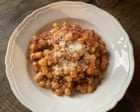
It was steaming out I doubt it capocollo Which caught my attention a few months ago. So much so that we, pesto kids in middle-aged bodies, came back an hour and a half later and sat down at the multicolored tiled counter to order it: dense, juicy, with an oily, reddish halo, and served over baby potato gnocchi.
Capocollo (pork neck), also known as pork collar or pork neck fillet, comes from the top of the pork shoulder, an area that is naturally marbled and generous with fat. It’s this marbled combination of meat and fat that contributes to the juiciness of this particular ragu, as well as to the ragu’s ability to not only stand up to but also benefit from three powerful herbs: bay, sage, and rosemary. What also struck me about Liu’s version is that he uses ground capocollo, rather than cooking a whole joint and then shredding the meat at the end — which is also great, but I prefer the texture that ground meat produces. Alternatively, you can mix lean cuts with back bacon, the key is a generous amount of fat.
Pork ragu with herbs (for gnocchi or pasta)
serves 4
400 grams Minced pork(It is best to be well-marbled with fat, such as the neck, shoulder, or jaw)
3-4 tablespoons olive oil
1 medium onionOr three peeled leeks and cut into small cubes
2 bay leaves
2 sage leaves
2 sprigs of rosemary; 1 leaf picked and chopped, and 1 whole
salt
1 small cup dry white wine
400 grams of tin Plum tomatoesOr crush it or pass it through a food mill
1 tablespoon Tomato center
500 grams of potato gnocchiOr fresh pappardelle
Grated parmesanOr grana padano
Working in a heavy-bottomed skillet or casserole over medium-low heat, fry the ground pork in the olive oil, moving it around the pan until it loses all of its pink. Add the onion, bay, chopped sage, whole rosemary and a pinch of salt, and continue cooking (and stirring) until the onion is translucent.
Add the white wine, bring to a boil for a minute or two, then add the canned tomatoes, tomato concentrate, another pinch of salt and a small cup of warm water. Cover the pot halfway with a lid and reduce the heat until the ragu simmers gently, about 2 hours. Check and stir occasionally, and add another small cup of warm water if the contents of the pan seem at all dry. By the end of cooking, the ragu should be thick but succulent with an oily halo.
Cook the gnocchi (or pasta) in plenty of well-salted boiling water, then remove to a warm bowl. Add a spoonful of finely grated Parmesan or Grana Padano, stir, then add half the ragu and stir again. Divide between four shallow plates or bowls and top with more ragu and more cheese, if you wish.



![root-vegetable-hash-with-avocado-cream-[vegetarian]-–-one-green-planet](https://globalindiabroadcastnews.com/wp-content/uploads/2026/02/19793-root-vegetable-hash-with-avocado-cream-vegetarian-one-green-planet-300x200.jpg "root-vegetable-hash-with-avocado-cream-vegetarian--one-green-planet | GIBN")