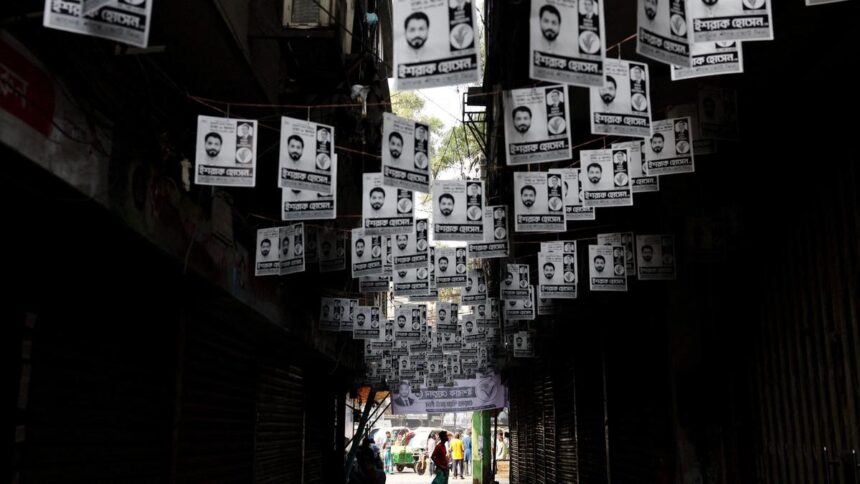

Election campaign posters hang on the street in Dhaka, Bangladesh on February 11, a day before national elections. Photo credit: REUTERS
The story so far: The fate of Bangladesh’s ‘second liberation’ will be decided on February 12, the day of its general elections. About 12.7 crore voters will cast their ballots for 300 seats in the Rashtriya Sansad (National Parliament) and a national referendum on the July charter.
Who will contest this election?
A total of 2,034 candidates contested in this election, including 275 independent candidates. There are 80 candidates from minority Hindu community and 85 women candidates. There were 17 Hindu MPs in the 2024 Rashtriya Sangad. Currently, there are 59 registered political parties in Bangladesh, 51 of which are participating in elections. There are two main factions – the Bangladesh Nationalist Party (BNP), and an 11-party alliance that includes Jamaat-e-Islami and the National Citizen Party (NCP). The BNP is contesting 292 of the 300 seats, leaving the rest to its coalition partners. Jamaat is contesting 224 seats; They have no women candidates, and only one Hindu candidate. The NCP, a youth party that emerged after the July Revolution, is contesting 30 seats.

What is the status of Awami League?
Awami League (AL), the party of Bangladesh’s ousted former Prime Minister Sheikh Hasina, has had its registration suspended by the Election Commission of Bangladesh. In May 2025, an interim government led by Mohd. Yunus banned all activities of the Awami League under the Anti-Terrorism Act. According to Transparency International Bangladesh, as of November 19, 2025, 1,785 cases have been registered nationwide against AL activists and supporters. Awami League joint general secretary AFM Bahauddin Nasim told The Hindu on February 8 that the party had boycotted the election and instructed its supporters not to vote. Hasina has maintained that the elections are undemocratic and that a majority of the population will boycott the polls.
What is a national referendum?
Aside from general elections, citizens will have to vote “yes” or “no” on the July charter. Ms. After the ouster of Hasina, following mass protests against her government, in 2024, faith was restored in Nobel laureate Mohammad. Yunus. Mr. Yunus was appointed as the Chief Adviser to the Interim Government and was also made the Chairman of the National Consensus Commission (NSS). The NSS was supposed to suggest structural reforms for the state, which included constitutional, electoral and judicial amendments. Out of 166 recommendations of the NCC, 84 were taken up to frame the “National Charter of July 2025”. Major reforms in the Charter centered around making constitutional institutions more independent, proposing a bicameral legislature, and increasing women’s representation in parliament. If the “yes” vote prevails, the newly formed parliament is bound to implement the provisions of the charter within 180 days. If it is “no”, the risk of one-party rule and weak institutions hangs over Bangladesh’s future.
Also Read | Bangladesh Elections Live
What are India’s observations?
Mr. Yunus invited India as an observer for the elections. More than 330 international observers have been invited to observe the previous controversial 2024 elections. India has not yet confirmed this invitation.
India remains Bangladesh’s largest trading partner in South Asia. Many infrastructure and connectivity projects such as Kolkata-Khulna, Agartala-Akhaura, Haldibari-Chilahati and 1,000 MW power export to Bangladesh and Tripura-Comilla power link are strategic pillars of this bilateral relationship. However, after the 2024 regime change, there is a degree of ambivalence between the two nations. Only time will tell how the relationship between the two neighbors will continue.
Tabshir Shams is a postgraduate student from South Asia University, Delhi.
Published – February 12, 2026 08:30 am IST