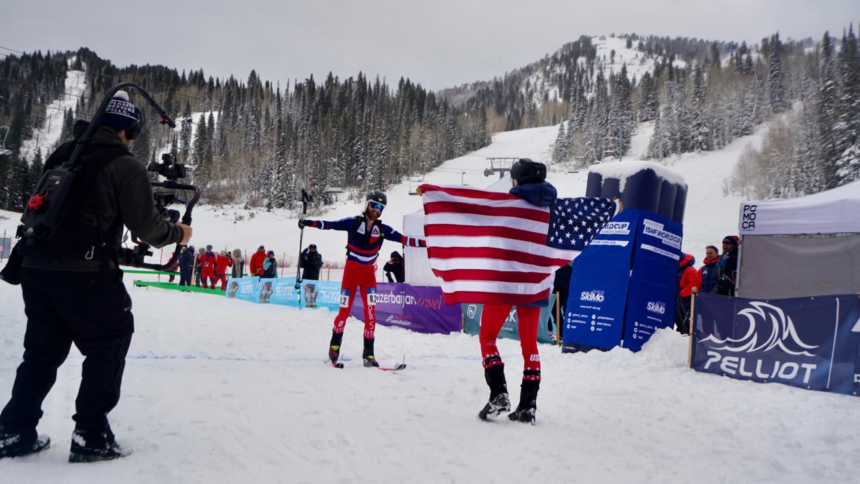
Olympic skating is a spectacle. Appearing in games for the first time, Skimo, short for ski mountaineering, grew out of a long tradition of climbing mountains on skis — sometimes for hours on end — for the reward of sliding down, preferably through untracked powder. But in the Olympics, this will involve sprints of about three and a half minutes. First, athletes ascend a steep slope on skis equipped with special fabric strips called “skins,” which prevent them from sliding backwards down the hill. Then they throw their skis on their backs and hike out in ski boots, then put their skis back on for the final ascent, and finally take off their skins to race down the slope.
The events will include a mixed-gender skimo relay race, “designed for the Olympic field,” Sarah Kockler, president of the sport for USA Skimo, the U.S. governing body for the sport, told me. Each team will include a man and a woman, and each will run the course twice. Anna Gibson and Cam Smith, both making their Olympic debut, will represent Team USA.
It is fitting that such a new sport would make its debut on the world stage in a format that is gaining new popularity. Mixed-gender events, in which each team is made up of a set number of men and women, have long had a place in the Olympic Games: figure skating and tennis were both introduced into the Olympics more than a century ago. But recently, the number of such events has increased as part of a deliberate effort to attract more attention to women’s sports. In Milan Cortina, every major sporting category except ice hockey features mixed-gender events.
Women participated in the first Winter Olympics, in Chamonix in 1924, but only in figure skating. Women’s speed skating exhibitions were included in the 1932 Olympics, but no medals were awarded. In 1936, women competed in alpine skiing, but were not allowed to participate in cross-country until 1952. Since then, the Winter Olympics have slowly been approaching some kind of parity, with women participating in an increasing number of events that were previously considered too difficult, dangerous or scandalous for them.
The International Olympic Committee is declaring the 2026 Games as “the most gender-balanced Winter Olympics in history.” This is based on the fact that women will represent 47% of participating athletes and compete in 53% of all events; These Olympics are also the first in which male and female cross-country skiers compete over the same distances. But in terms of viewership and publicity, several mixed-gender events may have a greater impact in raising the profile of female athletes than women’s events alone.
Women’s sports, including figure skating, tend to attract much fewer spectators than men’s sports. Smith told me that the mixed-gender relay can help bridge that gap, because in events that feature both men and women, spectators are in a position to watch everyone compete. And if mixed-gender events allow viewers to get to know more female athletes, that could translate into more people watching independent women’s events. The IOC is focusing on these events: The Los Angeles Games in 2028 will feature 25 mixed-gender events, including new events in golf, rowing and artistic gymnastics.
Gibson told me she had become accustomed to elite sporting spaces that separated men and women as much as possible in the name of fairness. She’s also a world-class runner and an accomplished gravel bike racer, and in those sports, “the talk was about giving women their own start in order to raise the level of women’s competition rather than burying women in the men’s field,” she said. Separate fields for men and women have been the default in most sports for a long time, and for good reason: If women had to compete directly with men, they would rarely have a chance to win. But bringing women and men together in competitions that include both gives women their own space and attention, while including all female athletes within one community. It creates “a lot of camaraderie,” Gibson said, and her experience heightens the excitement among viewers.
Of course, women face many obstacles in sports that cannot be solved by adding a few mixed-gender Olympic events. Across all sports, male athletes are generally paid more than their female counterparts. Kokler said the prize money in skimo is equal in the sport’s World Cup, but some other races still have unequal payouts. (Gibson said she avoids that.) Female athletes are still sometimes subjected to sexual harassment and assault, even at the Olympic level. The Winter Olympics still include one event in which women are not allowed to compete at all, the combined Nordic event, which consists of ski jumping and cross-country skiing. (The IOC is already considering excluding the Nordic countries combined due to low participation and spectator interest; an IOC spokesperson told me the event would “undergo a full evaluation” following this year’s Olympics, and reiterated the committee’s commitment to gender equality.)
Mixed gender formats remain vulnerable to unequal dynamics. Biathlon, a Winter Olympics event that combines cross-country skiing and target shooting, has used a mixed-gender relay format since the 2014 Olympics in Sochi. (Biathlon and luge were the first sports to offer a mixed-gender format at the Winter Games since figure skating and ice dancing in the 20th century.) But “women always come first in mixed-gender relays, and people feel it’s unfair that a woman can never be the anchor,” Joan Reed, a three-time Olympian who ran for Team USA, told me last week. In 2019, the sport’s governing body restructured the standings of the competition to rotate the gender of the broadcaster.
Although mixed-gender events are becoming more popular, Skimo’s inclusion in future Olympic Games is not guaranteed. It’s in the 2026 Olympics because organizers of this year’s games suggested it; To continue competing, figure skating athletes will need organizers in the following venues to also propose inclusion. Figure skating fans expect this to happen, and hope that future Olympic Games will include longer events that are more representative of the origins of the sport. “Nobody got into Skimo to do a sprint relay,” Smith said. But when he started training for the event, he enjoyed it more than he expected. “It’s really fun because we’re accountable to each other,” he said. “I race as hard as I can because I know it does the same for me.”