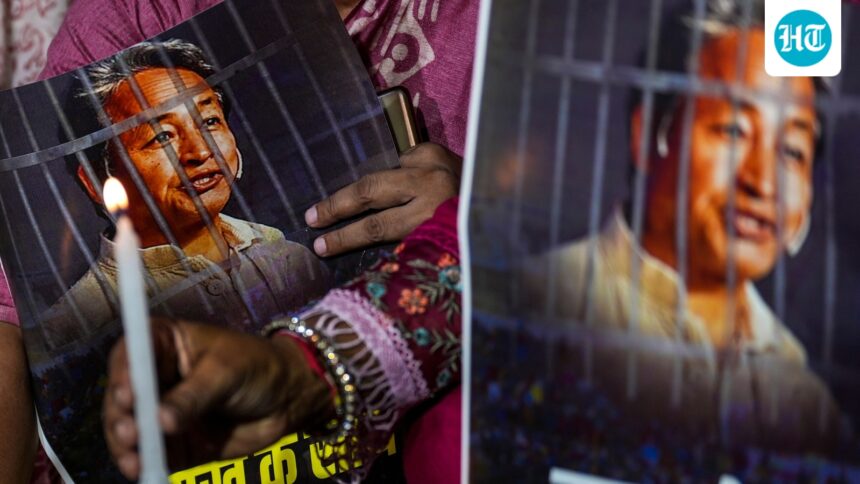
The Union Home Ministry on Saturday canceled the detention of Ladakhi activist, Sonam Wangchuk, under the National Security Act (NSA), citing the need to facilitate dialogue in the region, which has been demanding greater autonomy and climate protection within the Indian Constitution.

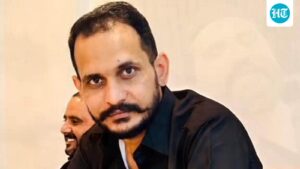
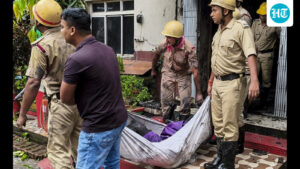
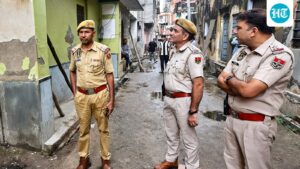
Wangchuk, 58, has been detained in Rajasthan’s Jodhpur Central Prison since September 26, 2025 – nearly six months – after ongoing protests in Ladakh turned violent in the main city of Leh in UT, where four people died and more than 160 others were injured.
The decision came on Saturday while the Supreme Court was hearing a habeas corpus petition challenging his detention.
The government has consistently maintained that he is “inciting” unrest.
But she said on Saturday that she needed to release him to ensure peace and end the “atmosphere of protest and protest” in Ladakh.
Sajjad Kargili, leader of Kargil Democratic Alliance (KDA) Which is cooperating with the Leh Apex Body (LAB) to meet Ladakh’s demands, it responded, saying: “The quashing of the NSA against Shri Sonam Wangchuk is a welcome step. However, our struggle for our legitimate rights continues.”
He demanded the release of activists Dildan Namgyal and Sammanla Dorji and “unconditionally dropping all charges against those detained on September 24.”
What did the government say about the release decision?
In a statement issued by the Press Information Bureau, the Ministry of Humanitarian Affairs acknowledged the broader impact that his continued detention has had on civil society in Ladakh.
“The prevailing atmosphere of protests and protests has damaged the peace-loving character of the society and has adversely affected various sectors of society, including students, job aspirants, businesses, tour operators, tourists and the general economy,” the ministry stated.
The government said it “remains committed to promoting an environment of peace, stability and mutual trust in Ladakh to facilitate constructive and meaningful dialogue with all stakeholders.”
The statement noted that Wangchuk “has already been subject to nearly half the period of detention” under the law — the NSA allows detention for up to 12 months — and reiterated a commitment to resolving Ladakh’s concerns “through constructive engagement and dialogue, including through the high-level committee mechanism as well as other appropriate platforms.”
What is the National Security Agency?
The National Security Act, 1980, is a preventive detention law that enables the central and state governments to detain any individual without trial if the authorities believe that such person is likely to behave in a manner “prejudicial to the defense of India, the relations of India with foreign powers, or the security of India”.
Unlike a regular arrest, which requires a criminal charge and trial, the NSA permits detention based only on a perceived threat. This makes it one of the most comprehensive provisions in Indian law. The maximum period of detention is 12 months, although it can be revoked before that, as has now happened in the Wangchuk case.
What the government argued in court about Wangchuk
The government’s detention of Wangchuk was vigorously defended before the Supreme Court by Solicitor General Tushar Mehta and Additional Solicitor General KM Nataraj over several months of hearings.
The Center claimed that Wangchuk bears direct responsibility for the violence that broke out in Leh on September 24, 2025, in which, according to Assistant Secretary-General Nataraj, four people were killed and 161 others were injured.
The Center and the Ladakh union territory administration told the court that Wangchuk was arrested on charges of inciting people in a sensitive border area related to regional sensitivity.
The center also claimed that Wangchuk tried to “incite Generation Z,” referring to those in their 20s, to hold protests similar to those seen in Nepal and Bangladesh. She noted that Wangchuk referred to incitement similar to the “Arab Spring.” Secretary General Mehta told the court that there was a “stark difference between Wangchuk’s rhetoric and Gandhi’s principles – it is chalk and cheese”.
The government also recently confirmed to the court that there was nothing medically concerning about Wangchuk’s condition. He was transferred to AIIMS Jodhpur in January for exams.
What his wife Gitanjali said: “Don’t be afraid of peace”
Wangchuk’s wife, Dr Gitanjali Angmu, filed a habeas corpus petition under Article 32 of the Constitution before the Supreme Court challenging the detention as illegal and unconstitutional.
The appeal alleged that the detention order was based on “senseless FIRs, vague assumptions and speculative assertions” and lacked any connection to the aforesaid reasons for detention.
Angmo also claimed there was a “witch hunt,” noting that the government, in the period surrounding his arrest, canceled a 40-year lease for the Himalayan Alternatives Institute, withdrew his NGO’s funding license, initiated a CBI investigation, and issued income tax subpoenas.
Angmo noted that Wangchuk publicly condemned the violence on September 24, 2025, via social media, calling it the saddest day of his life. He had also said that the violence would nullify five years of peaceful ‘tapasya’ (struggle) in Ladakh for statehood and protection of the Sixth Schedule.
Senior advocate Kapil Sibal, who defended Angmo, alleged that the police relied on “borrowed and selective videos” to mislead the detaining authority. He pointed out that there were contradictions between the allegedly “inflammatory” statements contained in the arrest warrant and the translated speeches that the Center presented to the court.
The Supreme Court bench of Justices Aravind Kumar and BP Varalli was scheduled to watch videos of Wangchuk’s speeches during the Holi holiday and was scheduled to reserve orders on March 17. The center’s decision comes three days before that.
In a recent X post, Gitanjali Angmo wrote that “fear is not peace.” The government lawyer said They had claimed in the Supreme Court that Ladakh became peaceful after Wangchuk’s arrest. “This could not be further from the truth,” she said, calling it a “logical fallacy” because correlation does not have to be causation.
“Secondly, it was not peace that followed — it was the terror that was sown: curfews and an internet blackout were imposed for weeks after September 24, over 100 youth were jailed for months (some of them still inside), and 4 youths were mercilessly shot dead under government orders by the Central Reserve Police Force (CRPF), social media posts attracting police summons and hours of interrogation even now,” she said.
“The eerie silence of the graveyard is not equal to the sacred peace of the temple for which Ladakh is famous!” Read her X post.