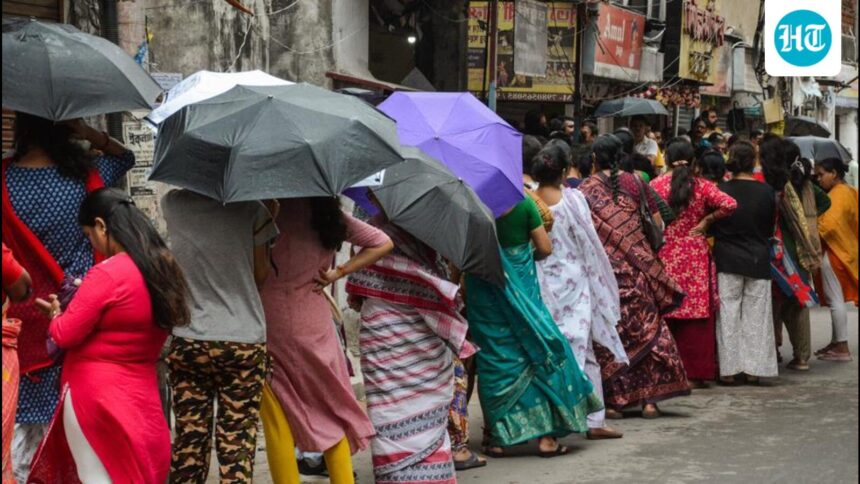
In March 2022, Prime Minister Narendra Modi credited women for the BJP’s victories in the Uttar Pradesh, Uttarakhand, Goa and Manipur assembly elections. “Where women voters outnumber men, the BJP achieves a landslide victory,” he said.

According to Lokniti-CSDS, a vast majority of upper caste Hindu women voted for the BJP in the 2022 Assembly elections. Successive governments launched special welfare schemes for women, but may have lacked a strategy to reap the electoral benefits. The BJP began growing its women’s vote bank after returning to power at the Center in 2014. The government introduced welfare measures like Ujjwala (liquefied petroleum gas delivery to below-poverty line households), linking toilets with women’s dignity, provision of free ration, and direct cash transfers. The party’s soldiers were going from house to house carrying “Modi guarantees”, including providing security for women.
When women started rewarding the party, the BJP gave them more tickets in national elections – 38 in 2014, 55 in 2019, and 68 in 2024.
Now, the BJP leadership is promoting the party as a champion of women’s empowerment, using the Women’s Reservation Bill as a key plank. The party machinery took an offensive stance, painting the opposition as anti-women, although it opposed linking the 33% women’s quota to determining boundaries. The bill was approved unanimously in 2023.
The opposition voted against the demarcation process and not the quota bill itself. But the BJP leadership took the warpath, organizing demonstrations and special sessions in state assemblies to condemn the opposition.
The bills to accelerate women’s quotas were moved amid elections in Tamil Nadu and West Bengal, two states where the BJP was electorally marginal. Women are also politically active there, and this issue did not have much resonance.
The issue of women’s quota will now be tested in the next round of assembly elections in the states of Uttar Pradesh, Punjab, Uttarakhand, Goa, Manipur, Gujarat and Himachal Pradesh in 2027.
So does the quota change the rules of the game, especially in states like Uttar Pradesh, where caste loyalties are well defined? Can the BJP make up for the cracks in the Hindu vote bank by supporting women? Does the opposition have any counter plan or rhetoric to thwart the BJP’s quota ploy?
Experts say women have witnessed political empowerment at the panchayat level and understood the value of reservation in the state assemblies and the Lok Sabha. But they are equally astute in seeing the BJP’s strategy.
The Samajwadi Party (SP) is the main rival of the BJP in Uttar Pradesh. The SP’s PDA formula of uniting backward, Dalit and Muslim voters helped it record its best performance, bagging 37 of the 80 Lok Sabha seats in Uttar Pradesh in 2024. The BJP’s seats in the state fell from 62 in 2019 to 33, with the party’s total number of seats falling below the majority mark in Parliament.
The BJP has been demolishing the image of the Socialist Party by raising issues of women’s safety and security and focusing on issues like “appeasing Muslims”. Will you use the 33% reservation percentage to unify the vote bank of women from all sects? Will women vote on an issue related to gender, sect or religion, which is the issue that has decided elections in the past?
The 2022 Loknity post-poll showed that women do not vote en masse and their votes are split in most elections. The survey found that women are no longer certified voters. The percentage of independent female voters has increased over the years.
The Socialist Party encourages young female candidates and promotes DNC women within the party hierarchy. The Congress formula of giving 40% to women in the 2022 elections did not yield much results as the party remained in disarray.
SP chief Akhilesh Yadav’s demand for a sub-quota for marginal communities within the 33% quota resonates. The National Federation of Dalits and the Adivasi organization termed the proposal to include women in the existing reserved seats, instead of providing separate reservation for them, as unfair.
Dalit rights activists say women from marginalized communities are still out of decision-making despite their election wins. They claim that without a sub-quota, the beneficiaries of the 33% quota will be women from politically, economically and socially powerful sectors. The government is unlikely to provide a sub-quota below which the process of women’s integration would remain incomplete.
However, the BJP’s ability to construct a narrative is unparalleled. Before the elections in West Bengal were over, Modi reached his Lok Sabha constituency in Varanasi to lead the quota drive and promised to ensure 33% reservation for women.
In the 2024 Lok Sabha polls, women’s turnout was higher than men’s in 17 of Uttar Pradesh’s 80 constituencies, compared to six in 2019 and none in 2014.
In the 2022 House of Representatives elections, 62.24% of women voted. The turnout rate for men was 59.56%. More women voted in 43 regions, compared to 55 in 2017.
The BJP became the first party to retain power in Uttar Pradesh in 2022 in 37 years. Now, the team is preparing to achieve its third victory in a row, hoping to gain the support of women.