When the Olympia Café and Shops opened in Colaba, a stone’s throw from the 1903-built Taj Mahal Hotel, Bombay was already a cosmopolitan port city bustling with Arab, Portuguese, English and Chinese merchants.

Founded by Iranian businessman Seyyed Mohammad Marab, Olympia became part of the wave of Iranian cafés that shaped the social and culinary culture of Bombay for the next century.
Read also | Tom Holland gets blasted by Indian fans at The Odyssey India premiere: ‘No one brings energy like you’
Christopher Nolan stops in Mumbai
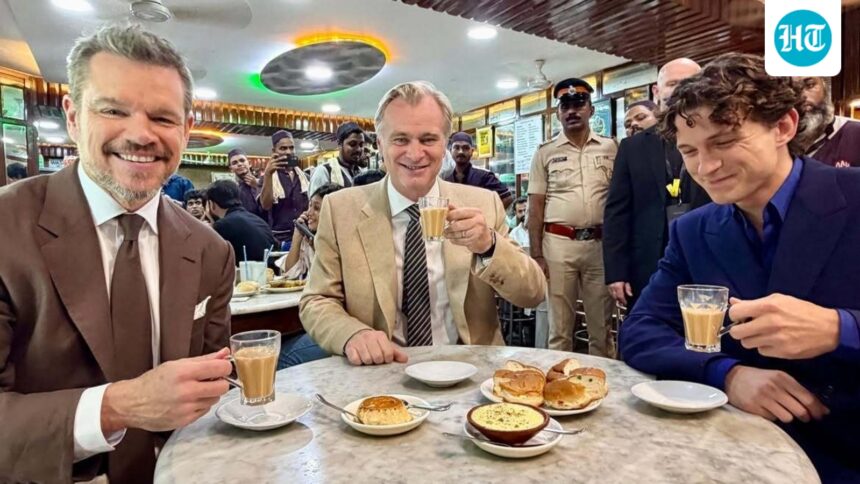
Anyone in their Indian team who has booked meals for Christopher Nolan and Odyssey stars Matt Damon and Tom Holland has clearly read about their history in Bombay. On their 48-hour stopover in Mumbai to promote their film, the A-listers stayed at the Taj Mahal Hotel and dined at Trishna restaurant in Kala Ghoda, which again is not surprising given its reputation for seafood. But it was Olympia’s choice that Nolan and his team surprised customers at the shabby-chic Iranian café when they showed up in tuxedos to order tea and maska cake.
Photos of the high-profile visit made it to the international press, giving a boost to Iranian cafes that had been struggling due to dwindling customers and glaring-eyed developers prowling to pounce on their prime real estate.
Cafe serving Old Bombay
Like most early Iranian sites in the city, Olympia doubles as a provision store where customers could obtain daily necessities such as soap, matches, and cigarettes while waiting for their drink or meal. Due to its location, it became a regular destination for a wide cross-section of Bombay, attracting everyone from Colaba dockers, office workers and local traders to passing travellers.
Read also | Ashish Chanchlani predicts Odyssey will be ‘amazing’, calls Matt Damon’s show: ‘Not a single dull moment’
By the beginning of the twentieth century, the name “Olympia” had truly international status. It was painted on the hull of one of the largest US Navy warships, and travelers regularly boarded an ocean liner of the same name on the route between India and England. Bombay had its famous landmark by that name too – the Olympia Theater on Grant Road where the country’s first feature film, Raja Harishchandra, premiered on April 21, 1913.
During this era, restaurants and cafés often adopted Greek or European names. These names exuded sophistication and modernity, appealing to both Indian and foreign customers while evoking an experience similar to that of European dining establishments.
The rise of café culture in Bombay
Café culture itself evolved from a much older tradition of coffee drinking in Bombay. Stephen Meredith Edwards (1873–1927), the British official who documented early life in Bombay, described the city’s coffee peddlers or kahwe-walas as a distinctive feature of Muslim quarters. These vendors, of Arab or Egyptian origin, carried portable stoves and kettles while announcing their arrival by rhythmically banging stacked coffee cups together.
Bombay in the 19th century also had Muslim cafes frequented by Arabs, Persians and local Muslims, where Urdu was the main language. Alongside them were European, especially Italian, cafés, catering to Europeans and Western-oriented Indian elites seeking European food without the social taboos surrounding dining.
World War I (1914-1918) reshaped India’s economy. As European industries shifted to wartime production, Indian manufacturers filled this gap. Industries flourished and job opportunities increased, creating demand for restaurants, cafes and entertainment venues. Olympia benefited from this rapidly changing urban economy.
legacy
As Bombay’s commercial districts expanded to Fort, Colaba, Grant Road and Byculla, refreshment rooms and restaurants became an essential part of city life. Evidence published after 1935 shows that Olympia also operated a nearby branch in Abu Bakar Manzil, known today as Metro House. Records indicate that it continued to operate until at least 1946.
In 1954, founder Syed Mohammad sold the Olympia garage to four trusted employees – Abd al-Rahim Suleiman, Abd al-Rahim Chowdhury, Gholam Rasoul, and Vali Mohammad – before returning to Iran. Their family has run the establishment for three generations, maintaining much of its original identity. After independence, Olympia gained a reputation for serving affordable Mongolian cuisine, attracting a larger clientele. Today it is still famous for its keema pav, bhija fry, mutton masala fry, dal gosht and brun maska, while retaining the casual atmosphere.