The statement said that in the event of any changes to agreed tariffs, the US and India agree that the other country may change its commitments.
The White House on Monday released the ‘US-India Joint Statement’ on the ‘interim’ trade agreement between the two countries, which details the expected trade deal reached after nearly a year of negotiations.
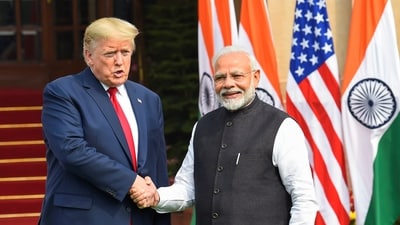
The trade deal was first announced on Monday by US President Donald Trump, who said Prime Minister Narendra Modi had agreed during a phone call to stop buying Russian oil. (PTI/File)The joint statement released by the White House reiterated US President Trump’s claim that India intends to purchase $500 billion worth of energy products, aircraft and aircraft parts, precious metals, technology products and coking coal over the next 5 years. It also said the US would reduce reciprocal tariffs on India from 25% to 18%.
Also read: White House releases India-US joint statement on ‘interim’ trade deal
Here is the full text of the joint statement:The United States of America (US) and India are pleased to announce that they have reached an Interim Agreement Framework on Mutually and Mutually Beneficial Trade (Interim Agreement). Today’s framework reaffirms the countries’ commitment to negotiating a broader US-India Bilateral Trade Agreement (BTA), which President Donald J. Launched by Trump and Prime Minister Narendra Modi on February 13, 2025, it will include a commitment to additional market access and support more resilient supply chains. The interim agreement between the United States and India will represent a historic milestone in our countries’ partnership, demonstrating a common commitment to reciprocal and balanced trade based on mutual interests and tangible results.
More Read

Also read: India-US Interim Trade Agreement on 12 points: What does White House’s joint statement say?
Key terms of the interim agreement between the US and India will include:
India will eliminate or reduce tariffs on all US industrial products and a wide range of US food and agricultural products, including dried distillers grains (DDGs), red sorghum for animal feed, tree nuts, fresh and processed fruits, soybean oil, wine and spirits and additional products.The United States will apply a reciprocal tariff rate of 18 percent under Executive Order 14257 of April 2, 2025 (Regulating Imports with a Reciprocal Tariff to Correct Trade Practices that Contribute to Large and Persistent Annual U.S. Merchandise Trade Deficits), as amended, on fine leather and footwear, plastics and rubber, biochemicals, home furnishings, artisan goods, and text in India. specific equipment, and, subject to successful completion of the agreement, will remove reciprocal tariffs on a wide range of identified products with potential tariff adjustments for aligned partners. (Changing Scope of Reciprocal Tariffs and Establishing Procedures for Implementing Trade and Security Agreements), as amended, including generic pharmaceuticals, gems and diamonds, and aircraft parts.Also read: Trump signs executive order announcing removal of 25% penalty tariff on India for buying Russian oil
More Read

The United States will withdraw tariffs on certain aircraft and aircraft parts from India imposed on March 8, 2018 (Adjustment of Aluminum Imports to the United States) to address national security threats; Proclamation 9705 (adjusting steel imports into the United States) of March 8, 2018, as amended; and Proclamation 10962 of July 30, 2025 (adjusting imports of copper into the United States). Similarly, consistent with US national security requirements, India will receive a preferential tariff rate quota for automotive parts subject to tariffs imposed to address national security threats under Proclamation 9888 (Adjusting Imports of Automobiles and Automobile Parts into the US) dated May 17, 2019. Depending on the outcome of the US Section 232 investigation into pharmaceuticals and pharmaceutical ingredients, India will receive the outcome of negotiations on generic pharmaceuticals and ingredients.The United States and India are committed to providing each other with preferential market access in areas of mutual interest on a sustainable basis.The United States and India will establish substantive rules that will ensure that the benefits of the agreement are primarily the United States It will be deposited only for the State and India.The United States and India will resolve non-tariff barriers affecting bilateral trade. India agrees to resolve long-standing barriers to trade in US medical devices; eliminating restrictive import licensing procedures that delay market access or impose quantitative restrictions for US information and communications technology (ICT) products; and, with a view to a positive outcome, determine within six months of the agreement’s entry into force whether US-developed or international standards, including testing requirements, are acceptable for US exports in identified sectors to enter the Indian market. Recognizing the importance of working together to address long-standing concerns, India also agreed to address long-standing non-tariff barriers to trade in US food and agricultural products.In order to facilitate compliance with applicable technical regulations, the United States and India intend to discuss their respective standards and conformity assessment procedures for mutually agreed sectors.In the event of any change in tariffs agreed upon by either country, the United States and India agree that the other country may change its commitment.The US and India will work towards further expanding market access through the negotiation of a BTA. The US confirms that it intends to take into account India’s request, during the BTA negotiations, that the US continue to work to reduce tariffs on Indian goods.The United States and India agreed to strengthen economic security alignment to enhance supply chain resilience and innovation through complementary actions to address third party non-market policies, as well as cooperation on inward and outward investment reviews and export controls.India wants to buy $500 billion in US energy products, aircraft and aircraft parts, precious metals, technology products and coking coal over the next 5 years. India and the US will significantly increase trade in technology products, including graphics processing units (GPUs) and other products used in data centers, and expand joint technology cooperation.The United States and India are committed to addressing discriminatory or countervailing practices and other barriers to digital trade and setting a clear path to achieving strong, ambitious, and mutually beneficial digital trade rules as part of the BTA.The United States and India will immediately implement this framework and work toward finalizing interim agreements with the goal of concluding a mutually beneficial BTA consistent with an agreed-upon roadmap on terms.
Follow the latest breaking news and developments from India and around the world with Hindustan Times newsdesk From politics and policy to the economy and the environment, from local issues to national events and global issues, we’ve got you covered.Read more