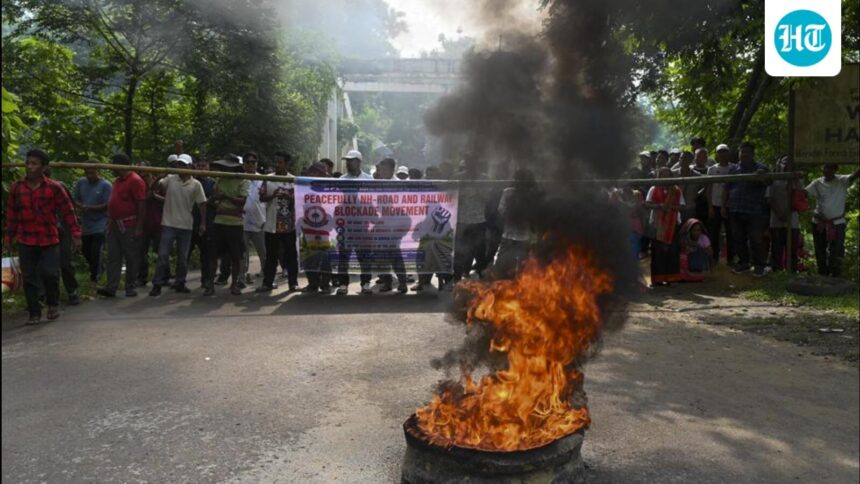
Members of banned militant groups National Liberation Front of Tripura (NLFT) and Tripura Tiger Force (ATTF) on Friday began a 72-hour strike across parts of Tripura, alleging that the Center and the state government have failed to implement rehabilitation measures promised under the peace deal signed almost two years ago.

The agitators blocked parts of the national highway and railway lines in Khwai district, demanding implementation of the decision $A rehabilitation package worth Rs 250 crore was announced as part of the four-way agreement signed in New Delhi led by Union Home Minister Amit Shah. There have been no reports of any untoward incidents so far.
The agreement was signed in the presence of Prime Minister Manik Saha, BJP ally, Tipra Mutha founder Pradyut Kishore Debbarma, and officials from the Home Ministry on September 4, 2024. Under the agreement, the Center agreed to $250 crore package for rehabilitation of rebels.
“An agreement was signed on September 4, 2024 that promised the Tibrasas a package of $250 crores for their rehabilitation. Nearly two years after the signing of the agreement, nothing of the agreement has been implemented. We have written to the central and state governments several times to look into the issue, but have not received any response. One of the demonstrators said: “In protest, we will hold a 72-hour strike starting today (Friday).”
The protesters said they had written to the Prime Minister, Chief Secretary, Home Minister, Tribal Welfare Minister and Tribal Welfare Minister seeking their demands met, but received no response. They also held a meeting with Tribal Welfare Minister Bikash Debbarma on Thursday, but the talks failed to produce any concrete results, prompting them to go ahead with the 72-hour strike.
At least 584 militants from the NLFT and ATTF returned to the mainstream after eschewing the path of violence in September 2024, three weeks after the central government signed a four-way settlement memorandum with the Tripura government and the two militant groups.
Militants from three NLFT factions, headed by NLFT chief Biswamohan Debbarma, Parimal Debbarma and Prasenjit Debbarma, and ATTF chief Alendra Debbarma, surrendered their weapons before the Tripura government at the headquarters of the 7th Battalion of Tripura State Rifles in Jamboijala, about 40 km from Agartala.
Tripura witnessed a series of bloodshed incidents involving several banned militant groups, including the NLFT and ATTF, from the 1980s to the early 2000s.
The National Liberation Front of Tripura (NLFT) was founded on 12 March 1989, by Dhananjoy Ring, a former rebel leader of the Tripura National Volunteers (TNV), which laid down arms in 1988 following the peace agreement signed between then Prime Minister Rajiv Gandhi and TNV chief Bijoy Kumar Hrangkhaul. A few years later, the leadership of the NLF passed to the Nayanbasi group.
Due to factional differences like most insurgent groups in the region, the leadership of the NLFT eventually passed to Biswamohan Debbarma after Nayanbasi, who had been removed from the group, formed another group called the Tripura Resurrection Army before surrendering along with his cadres shortly thereafter.
Just like the NLFT, the All Tripura Tiger Force (ATTF), another feared insurgent group in Tripura, was founded by former TNV members led by Bijoy Kumar Hrangkhaul in July 1990.
Initially formed as All Tripura Tribal Force, the outfit was renamed All Tripura Tiger Force (ATTF) in 1992, with Ranjit Debbarma as its supreme commander. It broke away from a faction of Tripura National Volunteers led by Commander Lalit Debbarma, who surrendered under the 1988 peace agreement.
The Government of India declared the NLFT and ATTF banned from insurgent groups in 1997 under the Unlawful Activities (Prevention) Act, 1967, citing their involvement in terrorist and subversive activities. These groups have also been banned under the Prevention of Terrorism Act (POTA) 2002.