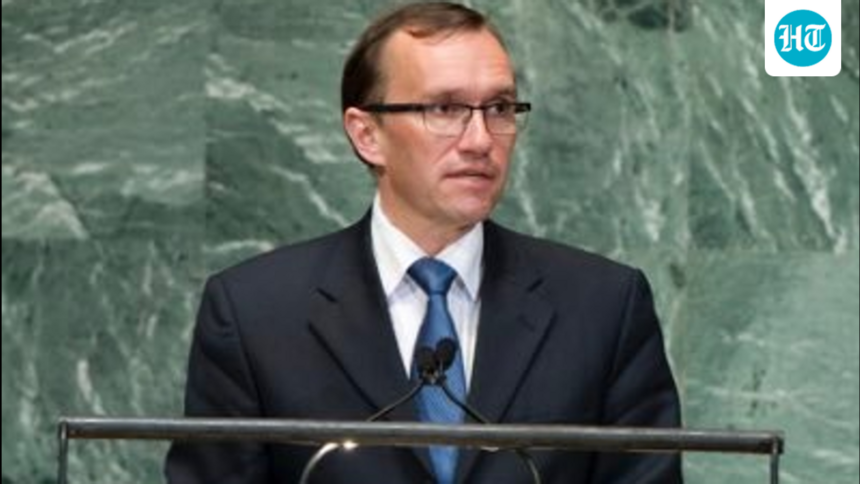
Norwegian Foreign Minister Espen Barth Ede said the EFTA-EU free trade agreements with India are complementary and will help avoid over-dependence on some countries.

Norway and India, as maritime nations, have been affected by the wars in Ukraine and West Asia and have a common interest in supporting a successful rules-based order, Eide told HT in an interview.
Tell us about the India-Norway Green New Strategic Partnership and your discussions with External Affairs Minister S. Jaishankar?
We have excellent political and economic relations between Norway and India. We recognize the growing importance of India – it is very close to becoming the third largest economy, but it is also a very innovative economy in IT, AI and many other industries. The Green Strategic Partnership is about how we shape the future through the kind of economic growth that is sustainable, more regenerative, and geared toward better use of the world’s resources. To achieve future growth, it is important that we connect these goals to your goals – creating more wealth to lift more people out of poverty and expanding the middle class, while doing so in a way that is consistent with life on this planet for hundreds of years.
Foreign Minister Jaishankar and I discussed the Strait of Hormuz, the war in Iran and the situation in Ukraine. These are issues that affect us all because both wars have huge impacts on the global economy and on our economies because we are maritime nations. We are keen on trade, we sell our products to other countries, we import from other countries, and we need an effective rules-based international trade system.
Norway has reservations about extending the exemption from US sanctions on Russian oil purchases, and it has been extended again. What is your view on Russia continuing to supply energy to countries like India? Does Norway believe that India can play a role in ending the war in Ukraine?
We would very much like to see India stress the importance of international law, especially the most important rule upon which civilized relations between nations are based – that we respect each other’s sovereignty. Invading and attempting to occupy the territory of another recognized sovereign state is a violation of the most basic rules. I believe that India, given its strong commitment to the United Nations, should convey this message to Russia.
We are ready to have a good relationship with Russia after this war, but it must be in line with international law, and we will all be better off when we respect these rules. I think India can play a role in this, and I welcome such a role in conveying this message, because as a BRICS country, it has closer relations with Russia. I see no reason to criticize this, but I think it should also be used responsibly.
When it comes to US decisions on sanctions, we prefer that the sanctions remain in place. We see that they work. Russia is not doing well on the battlefield after putting pressure on Ukraine for many years, which now has a bit of an upper hand because it has a slight edge in drone technology. Russia is not winning, but frankly we don’t really see a complete military victory for either side. At some point, we need a political agreement, and this should leave Ukraine as an independent, sovereign state free to make its own decisions, and then Russia can continue its business in Russia. No one is trying to change the leadership in Russia – that is the job of the Russians themselves if they want to – but what we want to do is respect international law and sanctions are part of it.
Have you been affected by the gray zone tactics you’ve blamed on Russia in recent months?
We see some of these hybrid threats emerging in our neighbourhood, less so in Norway than in the Baltics and some Central European countries. We stand in solidarity with them and I think it is important that we all learn and understand that wars today are not just about kinetic attacks, but they are also about undermining stability, increasing polarization, and using threats of shorter duration war that are still problematic to undermine the cohesion of other countries. This is something we talk about a lot in this part of the world and we are happy to share these experiences. I think India has some similar experiences, which is a good basis for conversation.
How do Norway and India intend to work in third countries under their new digital cooperation agreement?
Digital collaboration is extremely important. If you are in the digital space, there is no way not to work with India, as they are very dominant in programming and technology development. There is no relevant IT company in the world that does not have an office in Bengaluru, including ours. To advance this – not just digital as a business, but also how governments use digital technology, and how we create better societies and more effective governance through digitization and digital services – there is a need to work with India.
Norway was among the first countries in Europe to obtain a free trade agreement with India as part of the European Free Trade Agreement, and the European Union is scheduled to sign a free trade agreement with India by the end of the year. Do you see these two agreements as complementary to each other?
Yes. First, we are very happy that we were able to outmaneuver our good friends in the European Union by signing the agreement with India first – that was a small diplomatic victory for us. But to be more serious, we are actually happy that the European Union is also signing its agreement and that is because Norway, even though our trade relations are regulated through the European Free Trade Association and not the European Union, is still very closely linked to the European economy. What is good for the EU economy is good for us, and vice versa. We are deeply involved in European value chains, and we have a common vision with Europe to maintain interdependence while avoiding over-reliance on some other countries. It is also very good that we can strengthen our partnership with India, which is a fast-growing economy with the largest population in the world, and you simply have to get involved in this. I think the free trade agreement we have is a good agreement, and we welcome the EU agreement.