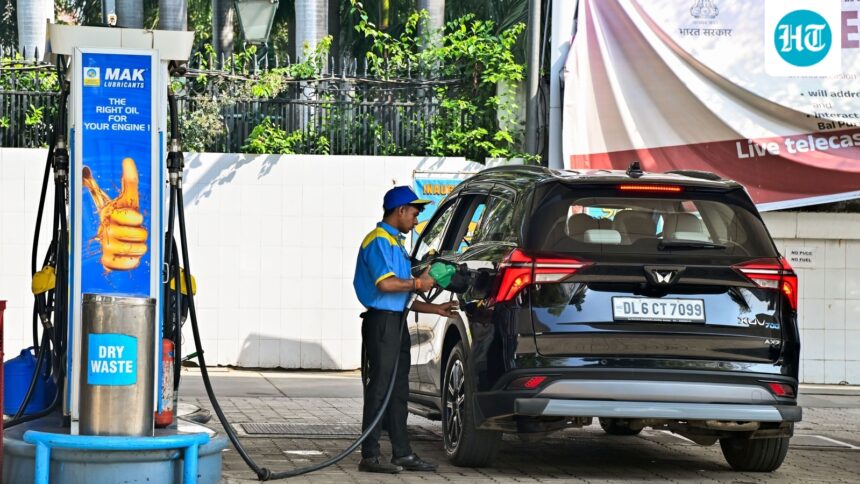
NEW DELHI: Indian refiners have adequate inventories, and public and private fuel retailers are maintaining regular gasoline and diesel prices even as the country’s average daily import cost has risen 120% to $156.29 a barrel since the start of the war in West Asia, government officials and corporate executives said on Sunday.

The average buying price for crude oil (called the Indian basket) was $71.17 per barrel before the outbreak of war on February 28, crossed the $100 mark to settle at $120.28 per barrel on March 9, began rising thereafter to exceed $140 by March 16 and crossed $150 to settle at $156.29 per barrel on March 19, according to the latest available government data.
India’s crude oil basket, which rose to $156.29 per barrel, set a new record high, surpassing even benchmark Brent crude, which reached $108.65 per barrel on March 19. To be sure, the Indian basket has often been a few degrees lower than Brent crude in the past. Even last time, when the Indian basket saw a peak at around $142 per barrel on July 3, 2008, it was around $4 lower than the price of Brent crude, which was around $146 per barrel.
The Petroleum Planning and Analysis Cell (PPAC), which is responsible for the oil ministry’s data, did not respond to a specific email query, asking why India’s crude oil basket prices were higher than Brent.
Despite the rise in crude oil prices, oil marketing companies in the public and private sectors continue to absorb higher input costs without raising the prices of regular petrol and diesel. Crude oil is certainly the main input into the processing of gasoline, diesel and other petroleum products, accounting for about 90% of total refining costs.
“In light of the evolving situation in West Asia, the Government of India continues to take proactive steps to ensure preparedness and response across critical sectors,” the Petroleum Ministry said in a statement on Sunday, while providing a daily update on the supply situation as the closure of the main sea route through the Strait of Hormuz has led to disruption in global energy supplies and escalation in prices. The statement added, “All refineries are operating at high capacity, with sufficient stocks of crude oil. The country also maintains sufficient stocks of gasoline and diesel.”
Private OMC Jio-BP said its mobility stations are “fully operational to serve customers and are adequately stocked”. Interestingly, while $2 litres”> State-run OMCs last week raised the price of premium gasoline by 100%. $2 per litre, the private fuel trader still clings to pumping up prices of premium and regular petrol and diesel.
“Jio-BP continues to offer high-performance petrol and diesel with Active Technology, which delivers greater mileage at no additional cost, ensuring greater value to customers,” the company said in a statement. Reliance BP Mobility Limited (RBML) operates the Jio-bp brand. Reliance Industries Limited’s (RIL) Jamnagar refinery is the largest and most complex single-site refinery in the world, with a production capacity of 1.4 million barrels per day of crude oil.
Thanks to its diversified crude oil procurement strategy that includes 40 oil-rich countries, India does not suffer from a shortage of gasoline and diesel supplies, unlike many neighboring countries such as Pakistan and Sri Lanka.
“No fuel droughts have been reported at any of the registration offices [retail outlets] By oil marketing companies. The Ministry of Petroleum said on Sunday that the government is reiterating its advice to the public not to resort to panic buying, as sufficient stocks of petrol and diesel are available and supplies are being maintained regularly.
But she said LPG supplies “remain a concern” in light of the prevailing geopolitical situation. He reiterated that no drought has been reported for LPG distributors for home cooking gas.
“Panic bookings have decreased. Delivery of domestic LPG cylinders is normal,” she added. The government is maintaining full cooking gas supply to over 330 million households by prioritizing LPG supplies to them and increasing LPG production in public and private refineries.
The LPG supply crisis has prompted the government to prioritize commercial LPG distribution through states and local administrations. Requests to hospitals and educational institutions have already been prioritized. The government has already partially restored commercial LPG supplies (20%) to consumers and, on March 18, proposed to allocate an additional 10% of commercial LPG to states based on ease of doing business reforms to expand pipelined natural gas (PNG), the statement said.
She added that on March 21, the government allowed the allocation of another 20% of commercial LPG to states, which will bring the total allocation to 50%. “This additional allocation of 20% will be given on priority to sectors like restaurants, dhabas, hotels, industrial canteens, food processing/dairy products, canteens/subsidized outlets run by the state government. Or local food bodies, community kitchens, 5 kg FTL food for migrant workers,” it said.
As about 47% of India’s total LPG imports were affected by the Iranian attack on the energy infrastructure in Ras Laffan Industrial City in Qatar last week, India is sourcing the fuel from diverse sources such as the US, Russia, Australia, Canada, Norway and Algeria. On Sunday, an LPG cargo ship, Pyxis Pioneer, from the US arrived at the New Mangalore port carrying 16,714 metric tons of LPG. This is in addition to the Russian crude oil tanker “Aqua Titan” bound for China, which was diverted to India. The ship carrying 0.77 million barrels of crude oil arrived in Mangaluru on Saturday.