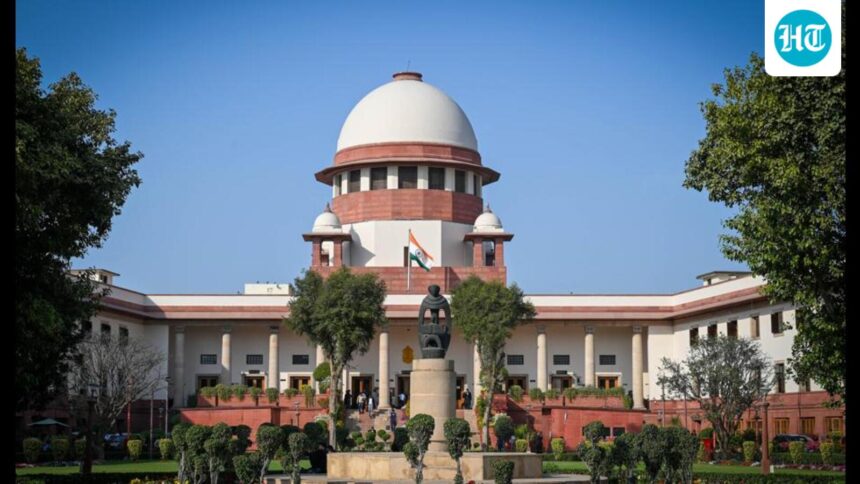
The Supreme Court on Monday stayed the implementation of the Madras High Court order directing the Tamil Nadu government to ensure that no cow or calf is slaughtered anywhere in the state whether on Bakred or on any other day, observing that the executive part of the apex court’s ruling requires “rectification” prima facie.
A bench of Justices Vikram Nath and Sandeep Mehta passed the interim order while issuing notice on a special leave petition filed by the Tamil Nadu government challenging the May 27 judgment of the Madras High Court. “The last paragraph of the Supreme Court order, prima facie, requires rectification,” the bench observed while maintaining the blanket ban.
Senior advocate Abhishek Manu Singhvi, who appeared for the state, said the Supreme Court’s directions effectively amounted to judicial legislation by imposing a ban that had no place in the legal framework governing animal slaughter in Tamil Nadu.
The state petition, filed through standing counsel for the state, Jayashree Narasimhan, contended that the apex court’s order is inconsistent with the Tamil Nadu Animal Preservation Act, 1958, which expressly allows slaughter of cows more than 10 years old if they are certified by the competent authority as permanently unfit for work or rearing.
It stated that the Animal Conservation Act, read in conjunction with the Prevention of Cruelty to Animals Act, 1960, the Prevention of Cruelty to Animals (Slaughterhouses) Rules, 2001, the Tamil Nadu Urban Local Bodies Act, 1998, and the Tamil Nadu Urban Local Bodies Rules, 2023, regulates the conditions under which animals may be slaughtered but does not impose a complete ban.
According to the state, by directing the complete ban, the Supreme Court replaced the legislative scheme with jurisdiction.
The impugned order was passed on May 27 by a bench of Justices GR Swaminathan and V Lakshminarayanan on the eve of Bakrid while deciding a public interest litigation filed by K Surya Prasanth, general secretary of Hindu Makkal Katchi.
The original petition sought directions to ensure that cows are not slaughtered at temporary or undesignated places in Coimbatore during Bakrid. However, the Supreme Court went beyond the relief sought and directed the Chief Secretary and Director General of Police to ensure that no cow or calf is slaughtered anywhere in Tamil Nadu whether on Bakred or on any other day.
The Supreme Court relied on a 1976 government order, which stated that a ban on cow slaughter would improve milk production and boost the rural economy. She also referred to Supreme Court decisions that held that cow slaughter was not an essential religious practice associated with Bakrid.
In its appeal against the ruling, the Tamil Nadu government alleged that the Supreme Court granted relief which was not sought or prayed for in the writ petition. The State also objected to the Supreme Court’s reliance on the 1976 Government Order, holding that there was no challenge to its validity or applicability in the proceedings and that executive instructions could not override statutory provisions enacted by the legislature.
The petition claimed that the Supreme Court ruling was internally contradictory. While part of the ruling recognized that slaughter of animals could only take place in designated abattoirs under the existing legal framework, the executive directives simultaneously imposed a complete ban on the slaughter of cows and calves across the state.
The state also took issue with the Supreme Court’s observation that the authorities had effectively admitted that cows were being or would be slaughtered in public places. According to the petition, the police have consistently maintained in their counter-affidavit that preventive measures have been taken to ensure that no slaughter takes place in public places and that any ritual sacrifice will be restricted to closed, non-public places.