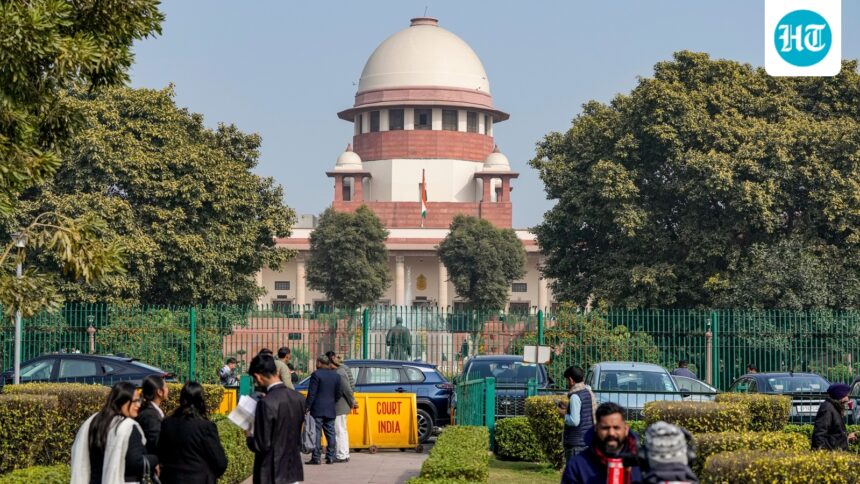
The Supreme Court has reinstated the dismissal of a senior bank manager, emphasizing that with power comes accountability, and that his position carries with it an increasing degree of responsibility and integrity.

The Supreme Court cited allegations that the senior manager colluded with an officer and a gunman to embezzle client funds for personal gain and steal bank records.
The Supreme Court set aside the Delhi High Court order, which modified the penalty of dismissal from service to compulsory retirement.
The Supreme Court had noted that for similar charges, different punishments were imposed on the other two offenders – the officer and the gunman – with the first director being given the maximum punishment without any difference in their roles.
However, the Supreme Court did not agree with this reasoning.
Read also | ‘Shocking’: Supreme Court criticizes ‘total failure’ of Bangladesh administration over holding judicial officers hostage in Malda
“Apart from that, it appears to us that equating a bank branch manager with a gunman is a blatant defiance of logic and reason,” a bench of Justices Dipankar Datta and Satish Chandra Sharma said in its April 2 ruling.
The court delivered its ruling on the appeal filed by the bank challenging the Supreme Court’s September 2024 order.
The Supreme Court indicated that the disciplinary authority imposed the penalty of dismissal from service on the first director.
The court also indicated that the disciplinary authority imposed a compulsory retirement penalty on the gunman, while the offending officer was granted a “two-stage reduction.”
“Whether imposing a reduced sentence on co-offenders while imposing a ‘dismissal’ sentence on the defendant (senior manager) is a clear defiance of reason? We do not think so,” the jury said.
She said that when he committed the offence, the defendant held a position of “senior manager on the MMGS-III scale,” which was clearly significantly higher than other offenders.
Read also |
“Power implies accountability; the higher the power, the higher the accountability. The rank of respondent was not merely nominal, but carried with it an increasing degree of responsibility and integrity.
“The defendant’s role requires not only personal obedience, but also supervision of the actions of his subordinates,” she said.
The court said that co-offenders, who have limited powers and authority, cannot be equal to the defendant. She also said that the seriousness of misconduct must necessarily be measured by the nature of the misconduct.
“Thus, for the Supreme Court to grant the benefit of equality to a defendant simply because co-offenders received a reduced sentence was a completely misconceived notion.
“The discrimination in rank coupled with the employer’s increased confidence in the defendant certainly constitutes a compelling basis for imposing a more severe penalty on him,” the bench said.
Taking a holistic view, the fact that the disciplinary authority found it prudent in the circumstances to impose a harsher penalty on a more senior official “was not disproportionate, and does not shock our conscience,” the Supreme Court said.
“Given the facts of the current case, we do not find any deviation or irrationality in the penalty imposed,” she said.
While accepting the appeal, the bench said, “Reinstatement of the punishment imposed by the disciplinary authority (i.e. dismissal from service) on the respondent.”
The bench referred to several judgments of the Supreme Court setting out the circumstances in which judicial intervention is justified in matters relating to the imposition of punishment by disciplinary authorities.
It observed that courts should exercise restraint when they object to punishment orders and, ordinarily, no court, in exercising its power of judicial review, should interfere with the punishment order imposed on the offender as a disciplinary measure by the competent authority and substitute its own judgment with its own.
“This is based on the fact that the disciplinary authority is the best judge of the situation and requirements for maintaining discipline within the workforce,” the council said.
She said the intervention might be justified if she appealed to the court that the disciplinary authority had “used a sledgehammer to crack a nut”.
He added that “a punishment that is strikingly or shockingly disproportionate and disproportionate to the seriousness of the misconduct, which was proven to have been committed during the investigation or otherwise, would amount to arbitrariness and would offend Article 14 of the Constitution.”