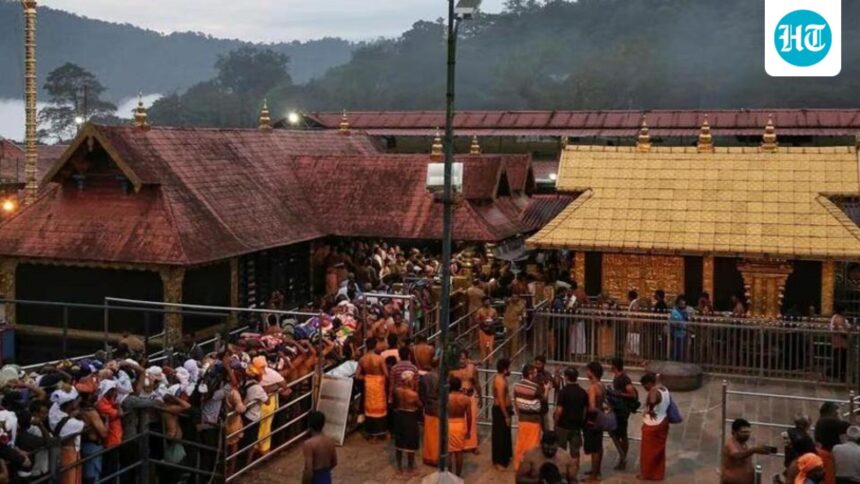
The Supreme Court on Saturday formally informed the formation of a nine-judge bench to hear a review of the long-awaited Sabarimala temple in Kerala, reviving a constitutional debate that has been in cold storage for six years and could reshape the court’s approach in dealing with religious rights disputes.

The bench will comprise Chief Justice of India Surya Kant and Justices PV Nagarathna, MM Sundresh, Ahsanuddin Amanullah, Aravind Kumar, AG Masih, R Mahadevan, Prasanna P Varali and Joymalia Bagchi.
The range of issues arising from a review of the 2018 ruling allowing entry of women of all ages into the Sabarimala temple was last taken up substantively in February 2020. They will now be heard from April 7, with arguments expected to conclude by April 22.
A three-judge panel led by ICC Surya Kant, and including Justices Joymalia Bagchi and Vipul M Pancholi, in February issued procedural guidelines for the reference hearing, which has since evolved into one of the most important religious freedom checks under the Constitution. The bench clarified that directions regarding the composition and composition of the nine-judge panel will be issued by the ICJ on the administrative side – a process that has now been completed with Saturday’s notification.
The court noted that as per the 2019 reference order, a bench of nine judges had been constituted. Objections to the continued referral of questions to a larger bench while review petitions were pending were finally decided in February 2020, when the court held that it had jurisdiction to refer legal questions to a larger bench even while review petitions were pending. After settling this issue, the way is now paved for deciding the matter.
Solicitor General Tushar Mehta, representing the Union government, submitted that the Center supports the review petitions and is actively opposing the entry of women of all ages into the temple.
The February 2020 order laid out seven cross-cutting constitutional questions, including the interplay between freedom of religion under Articles 25 and 26; The need to define the term “constitutional morality”; The extent to which courts can investigate certain religious practices; Meaning of “Hindu Sections” under Article 25; and whether the “essential religious practices” of a sect or a section thereof are protected under Article 26. Another question concerns the extent to which judicial recognition of political segregation laws challenging religious practices is permissible at the request of persons who do not belong to the sect in question.
The Sabarimala review will also anchor a broader set of issues that raise overlapping questions about the limits of judicial scrutiny in religious matters. The batch includes a 39-year-old case relating to the practice of excommunication of the Dawoodi Bohra community – the oldest case pending before the Constitutional Court – where excommunication results in social boycott and denial of entry to places of worship.
The nine-judge panel will also examine whether a Persian woman retains her religious identity after marrying a person of another faith under the Special Marriage Law, another dispute regarding the boundaries between personal faith and constitutional guarantees.
The revival of the Sabarimala reference represents a crucial institutional step after years of uncertainty following the 2019 review order and the 2020 ruling upholding the reference to a larger bench. The ruling is expected to have far-reaching implications for how courts balance basic religious practices, sectarian autonomy and individual rights. Together, the seven cases transform the Sabarimala review from a dispute over temple access into a foundational reconsideration of how the Constitution seeks to balance religious freedom, equality, reform, and judicial power.